Wednesday, 31 October 2012
Waltham Forest Cycling Strategy 2012-2015
An appendix to this year’s Waltham Forest Cycling Action Plan (see previous post below) is supplied by the new Waltham Forest Cycling Strategy 2012-2015 Scoping Document (which does not appear to be available on-line). A fuller strategy document is promised at a later date; there is little reason to believe it will be substantively different in its basic cycling policy.
As its title indicates, this short version applies a strategy to the Cycling Action Plan. Much of it could have been cut and pasted from almost any local authority plan to encourage and increase cycling – stuff like cycle training and promotion, and vague aspirations such as
work with partners in health, education and the police to bring about a significant increase in cycling.
To my mind it adds to the existing published Cycling Action Plan in only three significant ways.
Firstly it promises to “Substantially increase funding on cycle infrastructure and initiatives”. No concrete figures are supplied but various possible sources of funding are outlined and it is argued that “spending £10 per head of population per head is required to significantly increase cycling levels”. Encouragingly, “Spending £10 per head achieved a 100% increase in cycling levels in Brighton over 3 years”. This statistic is not sourced or further explicated.
Secondly, the Strategy promises to “increase the number of cycle trips to 2.5% by 2014 and 6% by 2026”. If the current TfL estimate for modal share in Waltham Forest is correct (0.8%) this will require a tripling of cycling journeys in just two years. This strikes me as being astonishingly ambitious.
Thirdly, there is greater clarity regarding infrastructure. The strategy states that action will be required in at least four key areas: infrastructure, training, promotion and enforcement. As far as infrastructure is concerned, the commitment is as follows:
The type of infrastructure will be determined through use of the DfT hierarchy of solutions which recommends that reducing the volume and speed of motor traffic should be considered first as they are potentially the most effective in promoting cycling. Preference will be for on road solutions as opposed to off road full segregation, as these can be achieved more quickly and at lower cost. However, where road speeds exceed 30 mph mandatory cycle lanes and/or segregated provision will be explored.
By a remarkable sleight-of-hand the London Borough of Waltham Forest’s affiliation to the LCC’s ‘Go Dutch’ programme is thus turned into a conventional vehicular cycling policy.
Leaving aside all the other little difficulties associated with the Hierarchy approach, there is no commitment to a grid of segregated cycle tracks, since the core primary route networks are 30 mph roads and by definition excluded from this strategy. Even on that handful of routes where the speed limit exceeds 30 mph there is no firm commitment to a segregated cycle track.
If cost is going to be an important factor, then painting a continuous white line to create a mandatory cycle lane in the carriageway will clearly be a more attractive option for a cash-strapped local authority. But even this miserable option will only be “explored”. It is perfectly possible that the kind of existing infrastructure to be found on a 40 mph route like Woodford New Road (i.e. a cycle path painted on the existing footway which fizzles out at junctions) will simply be retained.
I can see that the goal of reducing the speed of motor traffic is met by the introduction of a borough-wide 20 mph speed limit in all residential areas. However, there is no empirical evidence to show that this will bring about an increase in cycling with regard either to modal share or among those who live in such zones.
This Strategy fails to indicate how the existing volume of traffic on the borough’s roads will be reduced. Nor does it indicate to what extent this reduction needs to occur to bring about a surge in cycling. This particular goal does not strike me as being remotely credible.
All in all, this does not amount to a cycling strategy. It amounts to a fairly orthodox collection of quack remedies with a very long history of failure. Like earlier targets, these will fail and vanish into the memory hole. Like all previous London Borough of Waltham Forest transport documents this new one sets ambitious goals without ever considering the very substantial previous history of transport goals and targets not met.
The Strategy also recommends links to sources of useful information. These include
WF Cycling Campaign, TfL, LCC and CTC cycling pages.
There is one campaign group missing from the list, but I suppose this is logical since its strategic advice would be somewhat different.
Finally, this blog really only came back from the dead in reaction to the Waltham Forest Cycling Action Plan and the uncritical praise it received - with the added provocation in this ‘Olympic Borough’ of the Green Olympics cycling legacy.
It’s now time to take another break.
Take it away, guys…

Tuesday, 30 October 2012
Where ‘Go Dutch’ is going nowhere: the case of Waltham Forest
Part One: this Plan is not Dutch
Antonio Gramsci famously wrote
The crisis consists precisely in the fact that the old is dying and the new cannot be born; in this interregnum a great variety of morbid symptoms appear.
Among these symptoms may be included the London Borough of Waltham Forest’s 2012 Cycling Action Plan, which was greeted with rapture by certain bloggers who should have known better, and which - if you are looking for an example of hyperbole this will do nicely - was reported as bringing Amsterdam-style cycling measures to this particular car-sodden fragment of car-sick Greater London.
Before I proceed to bash this particular manifestation of ‘Go Dutch’ let me first of all say what I believe should be done to reverse cycling’s stagnation in an outer London borough like Waltham Forest.
A genuine Cycling Action Plan should, to my mind, have two basic features. First and foremost it needs to build a network of primary segregated cycle track routes across the borough; secondly it would close all residential areas to rat-running. This is my understanding of how the Dutch reversed their cycling decline, and I am not aware of any other evidence-based model which has been shown to work.
Let me enlarge upon these two core aspects with regard to Waltham Forest. The first thing that needs to be done is to establish basic bike grids across this relatively compact borough, i.e. physically segregated cycle paths on the high traffic volume primary routes. The major north-south route through the borough – its spine, as it were – is the A112, which runs between Chingford and Leyton via Walthamstow. The major east-west routes are the A503 (Forest Road) and the A104 (Lea Bridge Road). Add to that the A106 (Ruckholt Road/Eastway), a commuter route into the City, and High Road Leytonstone.
Here are some scenes from the A112. The Waltham Forest Cycling Action plan offers nothing to change conditions for cycling here. In the first photo, in the Chingford section, cars are parked quite legally in a cycle lane.


Turning these primary routes into safe, convenient, attractive segregated cycling routes (which obviously would require priority over all side roads and dedicated cycling-only green phases at major junctions) provides the beginnings of a network, which can then at a later date be enlarged. You do not then need to waste any money on a promotional budget to ‘encourage cycling’ because the attractions of cycling will be highly visible to anyone travelling in the borough. Such a network needs to be uncompromising in its adherence to the Dutch template. There is no reason in principle why such a network could not be built. On some sections all that is required is the re-arrangement of existing infrastructure, such as here on Chingford Road (A112), where the cycle lane has been placed alongside parking bays.


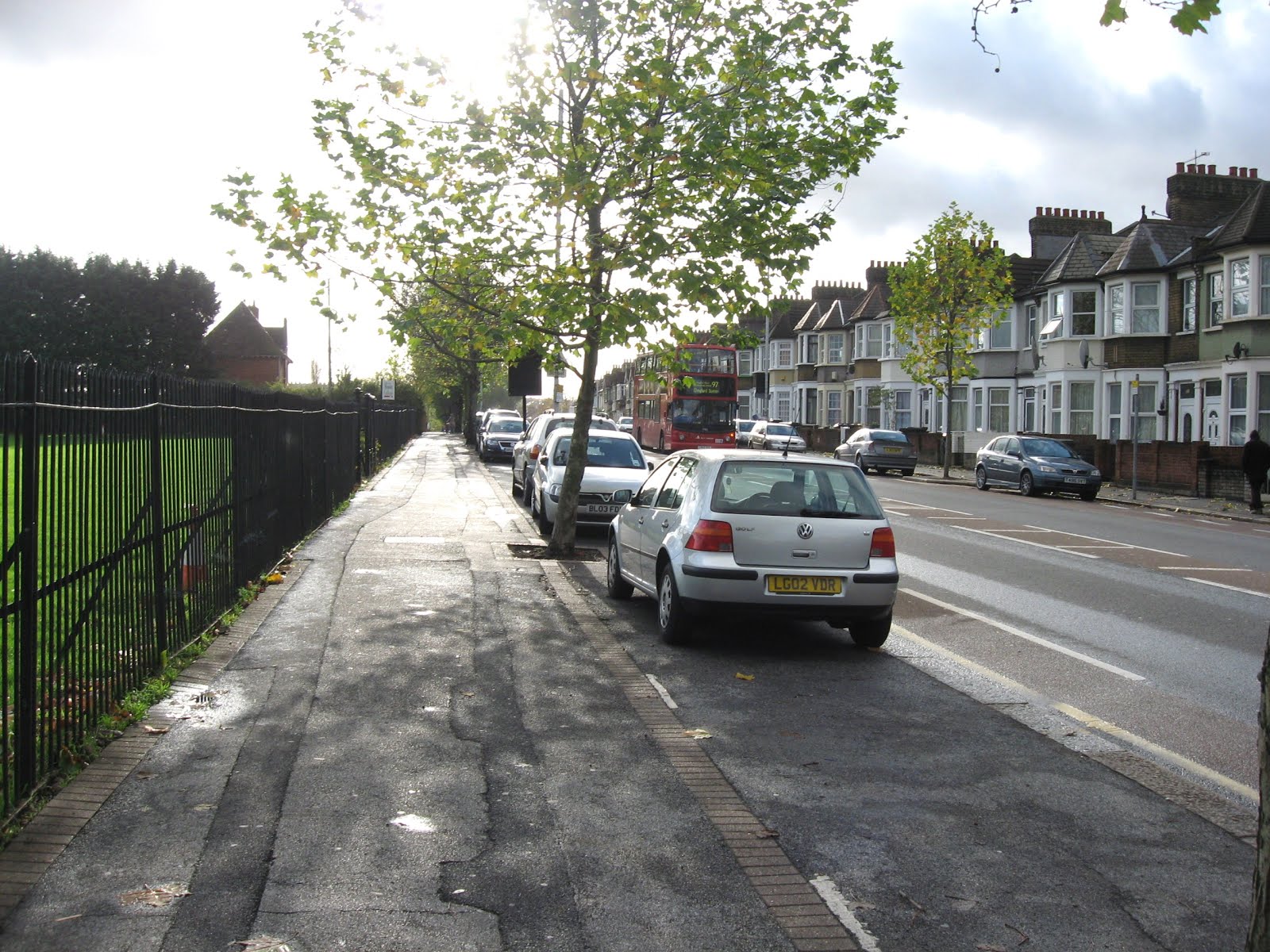
Instead of expecting cyclists to risk ‘dooring’ you move the cycle lane next to the footway and create a cycle track, and put the parked vehicles alongside the moving vehicles. Local residents don't have to lose their precious parking bays and cyclists gain a safe, segregated cycle path.
There is, of course, always the argument that there ‘isn’t enough space’. But while a section of the cycle campaign community keeps repeating this mantra, Waltham Forest Council has been busy re-allocating footways and cycle lanes for car parking on supposedly ‘narrow’ streets, as shown below.

(Above) The cycle lane and footway on Wood Street E17 (the B 160) being converted into free parking bays in December 2010.
(Below) Palmerston Road E17. A through route to Walthamstow's market and shopping centre. Space has been found here for parking bays along both sides of the road, even though this causes problems for two-way motor traffic.

The primary network then needs to be reinforced with a radical programme of road closures and one-way systems which halt rat-running through all residential areas, making access by car circuitous and access by bike straightforward and direct. Low speed limits and traffic calming obviously need to form another aspect of this support infrastructure.
However, the borough’s record of strategic road closures is very poor; they are few and far between, their implementation is incoherent and unsystematic, and even where a road closure has been introduced since the announcement of the new Cycling Action Plan no attempt has been made to provide cycling access. The council’s purported commitment to permeability could scarcely be more hollow and more contemptuously indifferent than here (below), where Somers Road E17 meets Palmerston Road. This is a permanent structure, not roadworks.

I don’t believe any other programme of action will reverse the stagnation of cycling in this part of Outer London. And the primary network has to come first. Trying to catch up with the Netherlands by shunning the key basics and by instead ‘pepper potting’, i.e. working to improve isolated and disconnected sites in the hope that one day they can all be joined up or that this in itself is sufficient to get more people cycling, who will then magically exert political influence, in my view simply isn’t going to lead anywhere but further failure.
What’s wrong with the new Cycling Action Plan? The problem with Waltham Forest Council’s supposed commitment to ‘Go Dutch’ is that it ignores the need for a primary network of segregated cycle routes, it does nothing whatever to stop rat-running, it in no way makes driving less attractive or less convenient and it does not re-allocate an inch of carriageway from the motor vehicle to the cyclist. Its solutions are wholly vehicular cycling solutions which in no way challenge the hegemony of the car. In short, the London Borough of Waltham Forest’s version of ‘Go Dutch’ is not remotely Dutch in practice.
The Waltham Forest Cycling Action Plan’s commitment to ‘going Dutch’ boils down to ten points, which fail to cohere into any kind of programme that is recognisably akin to the infrastructure to be found in the Netherlands. The full Plan can be read here - and now here is my point-by-point critique:
The first two points require certain commitments to lorry safety. However they apply only to lorries which come under the control of the local authority (most of the lorries on Waltham Forest’s road don’t). There is also the question of how such commitments will be effectively monitored and enforced. Finally, this kind of initiative is basically aimed at making it safer for cyclists and lorries to share the road, whereas Dutch planners prefer to keep cyclists and lorries separate.
The third commitment promises to ‘Identify the borough’s 20 most dangerous junctions and roads and introduce remedial measures to improve cycle safety.’
Apart from the issue of how ‘danger’ is defined and identified (this will doubtless be the conventional approach of using recorded road casualties), the promise of ‘remedial measures’ is lamentably vague but will almost certainly involve conventional ways of supposedly ameliorating the risks faced by vehicular cycling. A larger Advanced Stop Line and dedicated cycling lights which give cyclists a few seconds start ahead of motor traffic at signalled junctions appears to be about as radical as it’s going to get. It probably won’t even add up to that. This is, of course, not remotely Dutch. At the very least, cyclists need a dedicated cyclists-only green phase. But this, of course, would conflict with ‘network assurance’, i.e. smooth traffic flow. All transport planning in Greater London seems to be based on the core principle of accommodating and easing existing motor vehicle flow; there is no commitment to traffic evaporation.
Scepticism about the efficacy of this plan can only be reinforced by the fourth commitment, which starkly underlines its poverty at a fiscal as well as infrastructural level, promising at some point in the future to spend the risible sum of £100,000 “to support safe cycling and cyclists, on top of the existing £70k spent on cycle training.” A banquet requires more than a saucer containing a scattering of stale crumbs.
The fifth commitment to ‘Carry out an annual cycle count across the borough to accurately assess the full cycling levels in Waltham Forest’ would be more impressive if it didn’t simply reinstate a policy which was terminated two years ago. There is also the very big question of which roads are chosen for counts, and when and how often the counts take place. In the past the Council has preferred to focus on primary commuter routes (which give the best results) and moved the (very inadequate) annual one-day count from the autumn to the summer with an obvious view to getting the best figures possible. Massaging cycling statistics helps no one, unless all you are interested in is PR and self-congratulation.
The sixth commitment promises to ‘Improve consultation arrangements with the Waltham Forest London Cycling Campaign on all matters cycling and carry out a borough wide survey of residents’ views on our approach to cycling.
The kindest thing I can say about this is that this kind of consultation is unlikely to produce results which will be useful or enlightening. I am afraid there is a vast abyss between how I think a primary route such as Lea Bridge Road should be restructured for cycling and the kind of infrastructure which pleases cycle campaigners, as is starkly illustrated on Page 5 (printed number) of this document.
There is a further commitment to more cycle parking provision and a proposed improvement to the Bike Recycling Centre – worthy but not transformative initiatives and not in any sense uniquely Dutch.
At the end there are the two most ostensibly radical commitments:
Introduce a scheme to allow cyclists to ride in the opposite direction to the traffic flow in our one way streets. This will inform a Waltham Forest permeability strategy (maximum route choice, minimum diversion)
The problem with this is that the borough’s network of one-way streets exists for the sole purpose of managing traffic flow for the convenience of drivers and to maximise car parking. This is the antithesis of the Dutch approach to one-way networks, which designs out rat-running. The London Borough of Waltham Forest is one massive rat run and cycling can’t and doesn’t and won’t flourish in this environment. Simply allowing cyclists to ride against traffic flow doesn’t by default make cycling subjectively or objectively safe, or attractive.
Finally the Plan promises to Roll out a 20 mph default speed limit across the borough in our residential streets. The problem with that objective is quite simple. Whilst desirable from a casualty-reduction perspective, there is not a scrap of evidence that 20 mph zones generate new numbers of cyclists, for the simple reason that 20 mph zones on the British model do not deliver safe, convenient, attractive cycling. They do not in themselves modify in any significant way the car-centric status quo.
(Below) Conditions for cycling in a Waltham Forest area-wide 20 mph zone.

Part Two: things are getting worse for cycling, not better
The Cycling Action Plan does not address the need for safe, convenient primary routes in the borough. Nor does it address the very low modal share for cycling locally, or enquire what its causes might be. Amnesia, as usual, rules.
In reality conditions for cycling have been getting worse for cycling in recent years thanks to ’improvement’ schemes like these which involve putting cyclists alongside parking bays and narrowing the carriageway, putting cyclists closer to lorries etc. Things are about to get a whole lot worse on the borough’s primary north-south route, the A112. The council is about to do three catastrophic things on a section of this primary route connecting Walthamstow town centre with High Road Leyton.
Firstly, it is widening the footway, in the process getting rid of the existing cycle lane, with the result that cyclists will be pushed closer to motor vehicles on a route with high volume traffic including buses and lorries. Secondly it is introducing new central islands, which will create new pinch points and generate conflict between cyclists and large vehicles such as heavy goods vehicles. Cyclists will be squeezed out, which is a classic recipe for a fatality. Thirdly, the widened footway will be used to create parking bays, with the result that cyclists will face the threat of ‘dooring’. The idea that existing non-cyclists can be persuaded to ride their bikes on streets like these seems to me to be completely lunatic. But you would never know the catastrophic implications that this new project has for vehicular cycling from the council planners' smiley-smiley rhetoric:
The Council has been given funding by Transport for London to look at road improvements along Hoe Street between Third Avenue and Boundary Road. The changes will help to make this part of Hoe Street a safer, more attractive and more user-friendly environment for everyone, and will help encourage the use of safer and more sustainable modes of transport.
Hoe Street will be narrowed between Granville Road and Boundary Road as many people cross the road here. Narrowing the road will reduce traffic speed, and reduce the distance people have to cross. We are also proposing a footway loading bay here to improve access for deliveries and reduce traffic congestion.
New or improved central islands will be provided along Hoe Street to help people cross the road.
Additional cycle parking will be provided close to shops to make it easier for people to cycle as a mode of everyday transport.
The plans show all too clearly how space which is available in such ‘improvement schemes’ for a segregated cycle path is instead being used to make car driving and parking even more attractive (see below).
Needless to say when you look at the fine detail of the traffic order you will discover that free footway parking bays for motorists have been slipped in at the very last moment, long after the consultation was over, even though the original plan suggested that such bays would only be for business deliveries. The council planners have played this trick before: the Forest Road Corridor Scheme purported to be about reducing traffic speed, but after the consultation was over, the Traffic Order revealed that a new, hitherto-unmentioned aspect had been included: raising the speed limit from 30 mph to 40 mph on a section where the carriageway had been narrowed.
(Below) A waste of space. Car-centric planning to the detriment of safe cycling.


Part Three: Accessorize with ‘greater mutual respect’
As a substitute for meaningful cycle infrastructure we get associated 'Go Dutch' initiatives like this, announced in the council’s propaganda sheet Waltham Forest News, issue 74 (20 August), promoted with the endorsement and active support of the local LCC branch:

Six local driving schools have already signed up to Bikeaware, reducing road danger at source. Getting a driving license is a good thing. Not only opens it up another transport choice. It also gives people a thorough understanding of the Highway Code, which is after all important whichever way you get around. Bikeaware is a simple concept developed by an LCC trustee(www.bikeaware.org.uk). Waltham Forest has embraced this ‘pop up brand’ and six driving schools have already pledged to teach safe driving around cyclists.
Problems with that, anyone?
Check out the website and you’ll find gems like this:
This simple scheme would change the cycling landscape forever.
greater mutual respect would inspire less confident cyclists, particularly women, to saddle up.
Unfortunately, this is not evidence-based campaigning. And once again we witness cycling campaigners not even asking for what needs to be asked for, but instead settling for inferior vehicular cycling strategies with no history of success and which, all too predictably, will fail to increase cycling’s modal share in any significant way.This is, sadly, business as usual.
Monday, 29 October 2012
car-centric junction design
You can find junction design like this all over Britain. Part of the verge has been appropriated, rounded-off, and re-allocated as carriageway for the benefit of vehicles turning into, and emerging from, a side road. Pedestrians are sent on a diversion.


The purpose of this design may benefit larger vehicles, which require more space to turn, but it also encourages car drivers and others to approach or exit the junction faster than they might otherwise have done. This is bad for cyclists, since there is a greater risk of a ‘left hook’ (i.e. a driver overtaking and then immediately turning left) and also encourages some drivers to exit the junction in the face of an oncoming cyclist.
But it is also bad for pedestrians. It ignores the natural desire line. To be diverted for a distance of some ten metres up a side road in order to cross (with another ten metres to return to the original route) is inconvenient and adds to journey length and time. But it also greatly increases the chances of a pedestrian being knocked down while crossing, because this design removes the pedestrian from the sight line of drivers approaching from the rear. This creates the classic scenario for the speeding driver to assert that the pedestrian “just came out of nowhere”.


How could this design be improved?
The original sharp T-junction design could be restored, forcing drivers to turn in and out of the junction at much slower speeds and with much greater care. The footway needs to be reinstated to what must surely once have been its original route, directly across the junction, with no diversion.
Perhaps a better solution would be to keep the design but continue the footway across the junction in a straight line on a raised table. But for that to work there would need to be markings on the carriageway that gave pedestrians absolute priority.
Either way, existing junction design like this, which is found everywhere in the U.K., illustrates how fundamentally car-centric and hostile to walking and cycling street design in our society is. And most people won’t even notice; design like this seems as natural as the weather.
The location is Rawcliffe Lane at the junction with Brompton Road, in a city proud to boast that it puts the pedestrian first in its transport planning.
segregated cycle paths in Ottawa triple bike traffic
Bike traffic on Laurier Avenue has tripled with the installation of segregated lanes for cyclists, says a report from the city’s urban-planning chief John Moser, while about 100 cars have come off the downtown road at rush hours.
Regent Street to be closed to cars - for display of cars

Cycling-friendly Regent Street.
Where better to host a motor show than a street crowded with pedestrians?
Great cars from the 19th century to the modern day will be on display in Regent Street, London on Saturday November 3, as part of the free weekend of motoring hosted by the Royal Automobile Club.
Now in its third year, the the Regent Street Motor Show is claimed to be the largest free motor show in the UK. Although the street will be closed to traffic, the shops will remain open until 10pm.
Joining the 100 pre-1905 vehicles in the EFG International concours d'élégance will be low energy use vehicles as they arrive from Brighton having completed the RAC Future Car Challenge – some of these will not have been seen on UK roads before.
There will also be a display of beautiful cars owned by RAC members
Cycling in the dark
Lights are being turned off on motorways and major roads, in town centres and residential streets, and on footpaths and cycle ways, as councils try to save money on energy bills and meet carbon emission targets. The switch-off begins as early as 9pm.
They are making the move despite concerns from safety campaigners and the police that it would lead to an increase in road accidents and crime.
The full extent of the blackout can be disclosed following an investigation by The Sunday Telegraph
Pass your driving test with a bribe
A crooked driving examiner who took bribes of up to £1,000 a time to pass learners was today jailed for two-and-a-half years.
Police believe there could be hundreds of illegal drivers on the road after Richard Cwierzona, 49, offered to put candidates through who had failed their tests as many as seven times.
Sunday, 28 October 2012
more scenes from the Hierarchy of Provision
Both the CTC and the now defunct Cycling England (which lives on digitally) praise York as a city which puts pedestrians and cyclists ahead of motorists. Naturally York council is delighted by such praise and there is much mutual back-scratching.
Let me focus today on pedestrians in York, who are failed in this city at every level – including those of enforcement and infrastructure. You’d never know it from Cycling England, which illustrates this document with this:

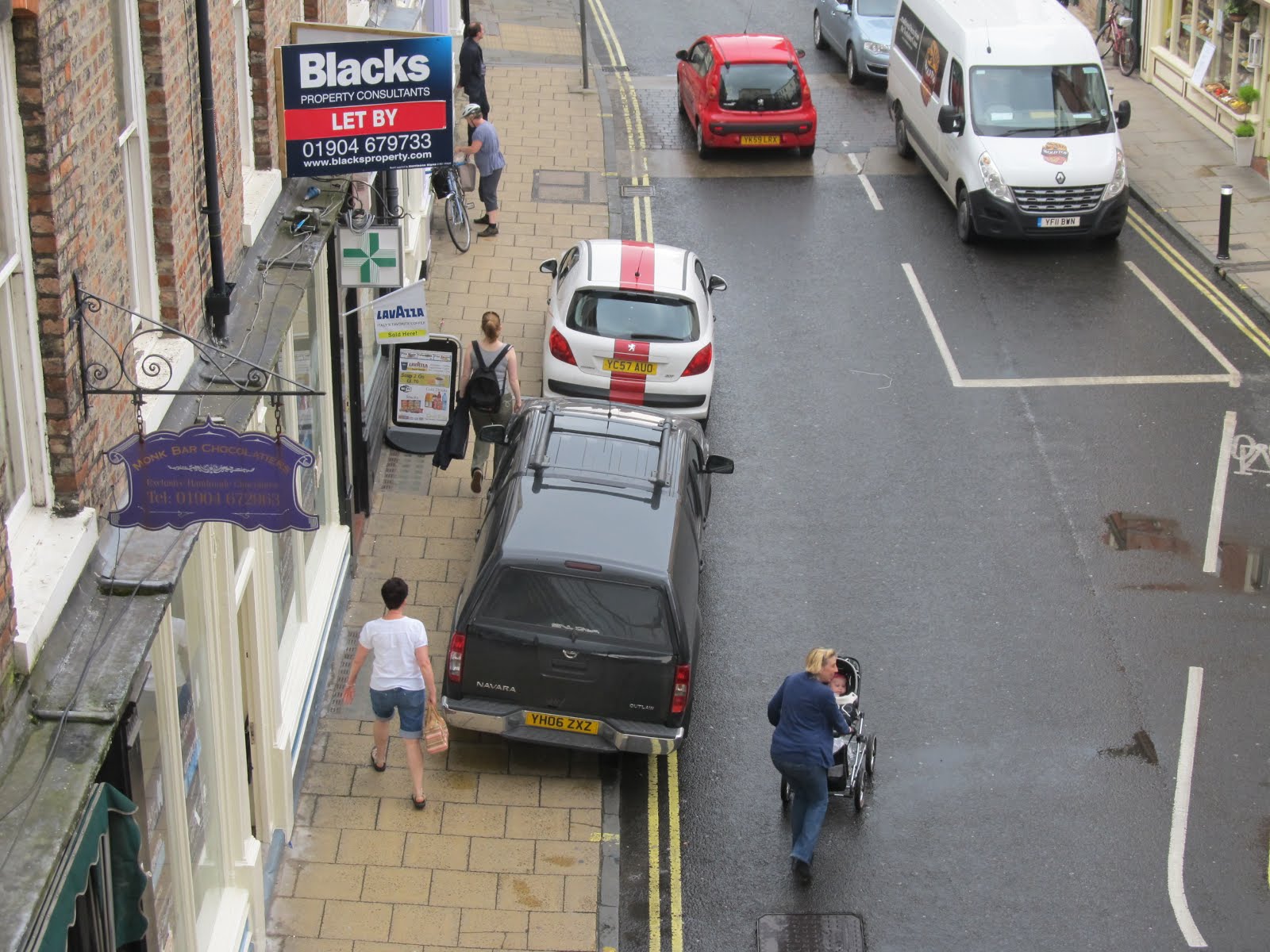
And now a scene from Goodramgate on a weekday. There are scenes like this all over York. Neither York’s car-centric police force, nor York’s car-centric council carries out enforcement against this kind of parking.

The vehicle shown above seems to be associated with a local business. It was still parked in the same position (but joined by a second unlawfully parked vehicle) when I passed by three and a half hours later and took these photos of a woman with a baby in a pram, who were forced out into the road in order to get past.


My next photographs show the crossing point between Lendal and Museum Gardens. Every day thousands of tourists on foot pour down Lendal and then have to find a way across vehicle-choked Museum Street to reach a large park beside the River Ouse which contains The ten-acre botanical Museum Gardens, a ruined abbey, and the Yorkshire Museum. And they get no help at all in crossing the road. Neither a zebra crossing nor a signalled crossing. York Council leaves them to get across a traffic-choked highway as best they can. In a city where pedestrians vastly outnumber drivers, and where cycling is stagnating, York Council puts motorists first and is every bit as committed to 'network assurance' (smooth traffic flow) as Transport for London.


Conspicuity Alert
Did you remember to turn back your clocks one hour?
At this time of the year it is now urgent that all cyclists remember to leave their Harry Potter invisibility cloaks at home. Too many cyclists are simply invisible to the naked eye, especially on today’s streets where drivers are busy multi-tasking individuals who have to concentrate on texting, drinking coffee, eating a sandwich, fiddling with a dashboard control, making a telephone call, or are in a trance induced by a SatNav.
Please remember to wear bright clothing and a helmet. This will impress the Coroner and count in your favour if your rear wheel should happen to inadvertently collide with a vehicle approaching from behind at 75 mph.
If possible cycle with a group of highly conspicuous friends.
And remember – some drivers won’t even notice you exist even if you are glittering like a lavishly decorated Christmas tree. This is why you should also carry something suitable to interact with motorists who come too close or with whom you may need to enter into dialogue regarding their standard of driving.

Killing of pedestrian hit by taxi driver on mobile phone ‘an accident’
Scrutinising the figures for prosecutions in London relating to deaths and injuries on the roads, Joe Dunckley asks why the far lower response rate to deaths than to injuries? Could it be that silent witnesses can't explain that they did not, in fact, "come out of nowhere"?
It is not infrequently the case that the only witness to the killing of a cyclist or a pedestrian is the driver who killed them.
In the absence of black box data recorders there is no objective evidence about speed or driver behaviour prior to a collision.
It is also the case that while cycling on pavements generates a huge amount of commentary, with people regularly reporting being ‘almost killed’, the actual violent killing of pedestrians rarely evokes any commentary at all. Here’s an example from an inquest a few days ago:
Gary Turner, 44, was run over in the early hours of New Year's Day as he was walking towards his home in Parklands, Coopersale, after a night drinking at the Black Lion pub in Epping with friends.
Taxi driver Martin Hignett told an inquest at Shire Hall, Chelmsford, yesterday, that he had no chance to react before he hit Mr Turner on the B181 Epping Road near the Coopersale junction shortly after 3am. He said it was not raining and he could see no other vehicles or pedestrians, so he was driving between 50mph and 55mph.
“I saw some movement towards my left,” he added. “It was almost in front of me when I realised it was a man and I had no time to react at all.
Mr Hignett said he had been using a hands-free mobile phone device while driving, but crash investigator Pc Steve Burton did not believe this had made a difference.
Footnote
Drivers using the legal alternative to hand-held mobiles are 30 per cent slower to react than those slightly over the limit, tests found. And for up to ten minutes after a conversation their reflexes remain dulled, according to the Transport Research Laboratory.
Other research indicating that the use of hands-free mobile phones reduces a driver’s concentration is described here.
The government raises two fingers to cycling safety
The government response to the Committee’s inquiry does not take up any of the recommendations in the report
Louise Ellman, Chair of the Transport Select Committee said today, Generalised talk about everyone playing their part to bring road casualties down should not be allowed to hide central government’s responsibilities to keep local authorities, the police, other agencies and the public fully focused on delivering significant and sustained improvements in road safety.
and
Martin Gibbs, Policy and Legal Affairs Director at British Cycling responded by saying “British Cycling shares the Transport Select Committee’s disappointment at the Department for Transport’s response to the Committee’s Road Safety inquiry.
"This is a disappointing response from the Government which lists a few modest measures with no central strategy for improving cycling in this country. It’s another missed opportunity.”
A few modest measures with no central strategy for improving cycling in this country pretty much sums up the condition of contemporary UK cycle policy at every level, does it not?
Incredible but true

Burdon Lane, Sunderland
A cyclist in Sunderland who had stopped to exchange details with a driver after a collision was fatally struck by another car, police have revealed.
Stan Coates, 55, of Sunderland, died in hospital after being hit in Burdon Lane at 16:45 BST on Friday.
Northumbria Police said two men in a Transit van claiming to know and live near Mr Coates had pulled up and taken the bicycle after the first collision. But the bike is now missing and police are appealing for witnesses.
Time to prosecute BMW for corporate manslaughter?
Isn’t it time that the directors of businesses like BMW found themselves in the dock on a charge of corporate manslaughter? They, after all, are complicit in building murder machines specifically designed to go at speeds twice that of the maximum national speed limit, and they bear some responsibility for the carnage on Britain’s roads. The anti-smoking lobby in the USA went down this route with great success, even though smoking is a voluntary activity.
The problem with the crap collaborationist ‘road safety’ lobby is that thoughts like this are completely outside the frame. In fact I can’t think of anyone who has ever suggested it before. Black box data recorders in every vehicle and prosecutions for corporate manslaughter are far better policies than asking cyclists to remember to leave their Harry Potter cloaks at home and try extra hard to be ‘visible’.
A speeding driver who killed a father-of-three when he drove at almost 155mph in an attempt to win back his girlfriend has been jailed for seven years. Shehzad Munir, 25, was showing off when he cut across three lanes and smashed his 4.5 litre BMW 6 series into Sukhpreet "Suki" Singh Chimber's car. The incident is believed to be one of the highest speed death crashes ever on Britain's roads.
Munir was convicted by the jury of causing death by dangerous driving. He travelled at excessive speed for some six miles.
Naturally under the British criminal injustice system this lethal yob will one day be allowed back behind the wheel of a car.
Footnote
Let’s not forget BMW and the Olympics.
Saturday, 27 October 2012
‘We cannot carry on like this’
We will have to change and we will all have to contribute to building a better country. But our political system is an obstacle to this kind of popular involvement because it is dominated by the rich and powerful.
This heart-rending appeal for a better Britain comes from man of the people, left-winger Jon Cruddas MP.
A plucky defender of the rights of the little people, and a simple, plain man whose chosen means of mobility in central London is, er, a gigantic gas guzzling 4X4.
And that’s not all…
Jon Cruddas, 50, was driving a Land Rover Freelander near Hyde Park in central London on July 6 when he was pulled over by officers who noticed what appeared to be a defective brake light. The MP for Dagenham and Rainham, who is chairing Labour's policy review, was banned from driving for eight weeks for not having any insurance and fined £300 for an expired MOT.
"When he was pulled over, he said 'sorry I don't have insurance'". The court heard that Cruddas already had six points on his license for speeding, so a further six points would have meant a compulsory driving ban.
Mark McDonald, mitigating for the MP, said Cruddas put paying for everything on a "to-do" list, but simply forgot about it. "He drives round his constituency and there is an enormous amount to deal with. He has to go to his constituency, he has to go to Parliament so he will have to catch public transport."
Referring to the six points Cruddas already had on his license, District Judge John Zani said "the trouble is six and six make 12" - the MP would get an automatic ban.
Spot the difference between the Mayor of New York and the Mayor of London
Today Mayor Bloomberg made an appearance at a major gathering of transportation agencies from across the nation and, with NYC DOT Commissioner Janette Sadik-Khan at his side, said out loud what the tabloids have always suspected he feels on the inside: People in cars are third class citizens.
Originally, "the streets were there to transport people," Bloomberg said. "They are not for cars... One of the original ways was walking."
And he didn't stop there. "Cyclists and pedestrians and bus riders are as important, if not, I would argue more important, than automobile riders," Bloomberg declared
Crap cycling in Dorset
Cycle event organiser David Wade warns newcomers that aggressive driving is all too common on Dorset’s roads. “We held a hill climb event on Sunday and once again our members were victims of aggressive drivers,” he said.
“Motorists still argue they have absolute right of way.
Police are still searching for the occupants of a gold car thought to be responsible for attempting to push two cyclists over as they rode through Poole last month.
Crap cycling in Peterborough
A petition to introduce a cycle lane through Peterborough city centre has already picked up 78 signatures in its first few days.
Darren Fower, Peterborough city councillor for Werrington South, wants a lane through Bridge Street to allow cyclists to pass freely.
He launched the online petition at the weekend calling on the council to make the change. He said: “We are supposed to be a city that is aspiring to be an environmental capital. “The reality is cyclists are demonised and we do everything to protect drivers. We need places to lock up bikes and a safe way into the city centre.”
dangerous Manchester
how Greater Manchester fire service spends its time:
“Our fire fighters rescue more people from road traffic collisions than they do from house fires
Thursday, 25 October 2012
James Bond and cyclists

(Above) Sean Connery on a bicycle
My current bedtime reading is Ian Fleming’s Casino Royale, first published in 1953. And when I came to Chapter 15, where Bond goes on a high-speed car chase after the abducted Vesper, I was startled to read this sentence:
Bond’s mind raged furiously on with the problem as he flung the great car down the coast road, automatically taking the curves and watching out for carts or cyclists on their way into Royale.
James Bond watches out for cyclists!
This is very impressive. One does not associate 007 with a commitment to road safety.
The ‘great car’ is, of course, a modified 4½ litre Bentley.

I wish I could end it there but I’m afraid the paragraph contains two more sentences which rather take the edge off Bond’s concern for cyclists:
On straight stretches the Amherst Villiers supercharger dug spurs into the Bentley’s twenty-five horses and the engine sent a high-pitched scream of pain into the night. Then the revolutions mounted until he was past 110 and on to the 120 mph mark on the speedometer.
So I’m afraid if Bond had met a cyclist, the miscreant would have just appeared out of nowhere.
(Below) The kind of typical cyclist who 007 might have encountered in France in 1953 if our hero hadn’t been racing around in a supercharged Bentley. Hard luck, James!

The human aftermath of the latest London cycling fatality
The husband of a cyclist killed in a collision with a lorry told today of the “nuclear” effect that the loss of a “wonderful, caring, vivacious person” had had on his life.
Subscribe to:
Posts (Atom)