Showing posts with label pollution. Show all posts
Showing posts with label pollution. Show all posts
Tuesday, 19 July 2011
Friday, 8 July 2011
‘Cabbies and cyclists have a common cause’
Cabbies and cyclists have a common cause re access to the #ORN & should campaign and lobby and protest together.
And as anyone who has ever been on London’s Critical Mass will know, black cab drivers are just natural allies, are they not? They always want to join in, blowing their horns in solidarity and sometimes even jumping out of their cabs to engage in a vigorous discussion about the best use of road space.
A reserved lane just for black cabs and cyclists and Olympians in limos. What a marvellous mix that would make. But, hey, you can try that idea out any day on Euston Road! See if you can spot the cyclist.

Shortly after I took the pic above I heard a siren wailing. Look carefully in the photo below and you’ll see a yellow emergency ambulance. Its blue light was flashing and its siren was wailing. The ambulance was stationary. It was held up by congestion. Obviously the preferred TfL solution here would be to reduce crossing times for pedestrians, because after all that’s what 83% of pedestrians want. And as many top cycling campaigners will tell you, on London's narrow streets there just isn’t the space for a separate Dutch-style cycle track – anyone can see that.

Footnote
For some strange reason Euston Road is one of the most polluted areas in London. (Note that Boris Johnson's Air Quality Strategy includes the brilliant 'Changing signal timings to smooth the flow of traffic'.) On Wednesday there will be a protest.

Thursday, 7 July 2011
Cycling protest – central London Wednesday 13 July

SOHO SQUARE
Gather 6.30pm, Ride off at 7pm
Wednesday 13th July 2011
We’re acting because:
- Clean air in the city would prevent about 4,300 premature deaths each year.
- Breathing London’s air reduces the life expectancy of those who die prematurely from it by 11 years on average.
- Air pollution from our busiest roads exacerbates asthma and may cause it.
- Deaths and illnesses from air pollution in the capital cost up to £2bn a year.
Air pollution in London is the worst in the UK and among the worst in Europe, with fatal consequences. But we can do something about it. Climate Rush are organising a cycle flashmob.
Saturday, 23 April 2011
Car sickness makes you sick
Monitors on the traffic-choked Marylebone Road were showing readings breaching European Union limits on ozone and pollutant particles linked to respiratory and other health problems.
and
Professor Warren Lenney, of the British Lung Foundation, said air pollution posed a big risk to young children because it can damage their lungs, restricting their airways and making them more prone to asthma. The professor said: ‘We should be breathing normal healthy air with no soot, ozone or toxic nitrogen dioxide because all those things come into your airways and they produce inflammation.
'This then scars the lung tissue which results in smaller airways and can cause asthma, chronic obstructive pulmonary disease and lung cancer.
‘The smog that we are seeing this weekend is as bad as in Dickens’s time in Victorian England.
‘Then, it would have been really bad in November due to all the industrial smoke, but today it is somewhat worse due to the car exhaust fumes.
and
Pollution in towns and cities including London, Oxford, Sheffield, Liverpool and Leeds was as much as double safe levels, according to official data.
The pollution poses a particular risk to asthmatics, the elderly and heart patients, who are being advised to be vigilant to any change in their conditions and to seek medical help if they experience difficulties.
Research has found that particulate matter causes between 12,000 and 24,000 premature deaths a year in Britain. In 2007 scientists at the University of Southern California found that children who lived within 500 yards of a main road had stunted lung development.
Yesterday 39 sites in the UK exceeded the limit for PM10s. The pollution has been exacerbated by the number of people driving. An estimated 18 million vehicles will travel over this weekend and next.
Simon Birkett, of the Campaign for Clean Air in London, said: “It is a scandal the so-called 'greenest government’ is still virtually silent on the long-term impacts of air pollution on health.”
Time to remember once again the naïve enthusiasm with which the last CEO of the London Cycling Campaign welcomed the prospect of a cycling prime minister and a cycling mayor.
And don’t forget the car dependency and the obesity.
and
Professor Warren Lenney, of the British Lung Foundation, said air pollution posed a big risk to young children because it can damage their lungs, restricting their airways and making them more prone to asthma. The professor said: ‘We should be breathing normal healthy air with no soot, ozone or toxic nitrogen dioxide because all those things come into your airways and they produce inflammation.
'This then scars the lung tissue which results in smaller airways and can cause asthma, chronic obstructive pulmonary disease and lung cancer.
‘The smog that we are seeing this weekend is as bad as in Dickens’s time in Victorian England.
‘Then, it would have been really bad in November due to all the industrial smoke, but today it is somewhat worse due to the car exhaust fumes.
and
Pollution in towns and cities including London, Oxford, Sheffield, Liverpool and Leeds was as much as double safe levels, according to official data.
The pollution poses a particular risk to asthmatics, the elderly and heart patients, who are being advised to be vigilant to any change in their conditions and to seek medical help if they experience difficulties.
Research has found that particulate matter causes between 12,000 and 24,000 premature deaths a year in Britain. In 2007 scientists at the University of Southern California found that children who lived within 500 yards of a main road had stunted lung development.
Yesterday 39 sites in the UK exceeded the limit for PM10s. The pollution has been exacerbated by the number of people driving. An estimated 18 million vehicles will travel over this weekend and next.
Simon Birkett, of the Campaign for Clean Air in London, said: “It is a scandal the so-called 'greenest government’ is still virtually silent on the long-term impacts of air pollution on health.”
Time to remember once again the naïve enthusiasm with which the last CEO of the London Cycling Campaign welcomed the prospect of a cycling prime minister and a cycling mayor.
And don’t forget the car dependency and the obesity.
Saturday, 26 March 2011
Cycle parking in central London
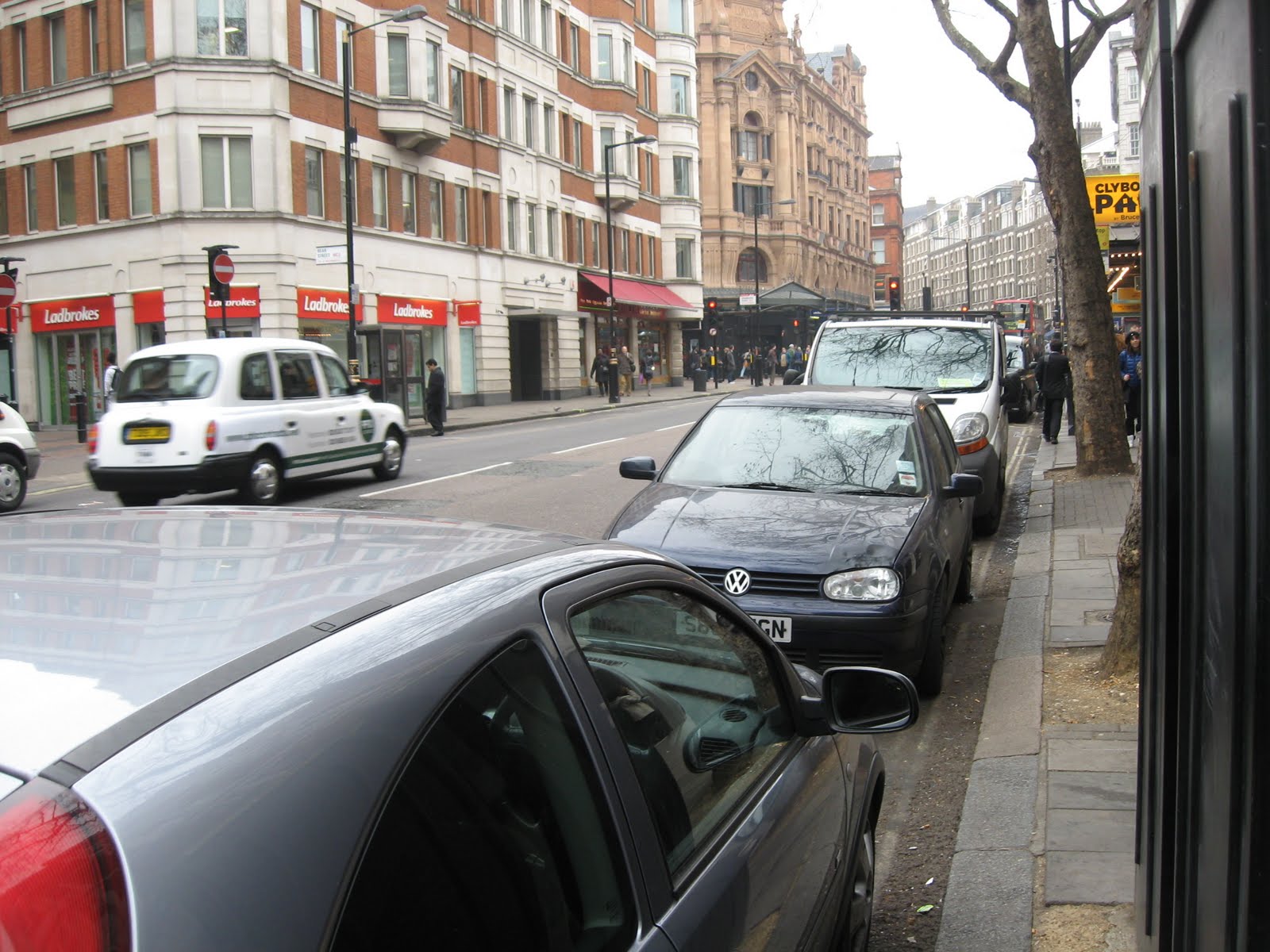
(Above) car parking on Charing Cross Road . It’s a shame the road is too narrow for a segregated cycle path innit.
(Below) cycle parking on Charing Cross Road.
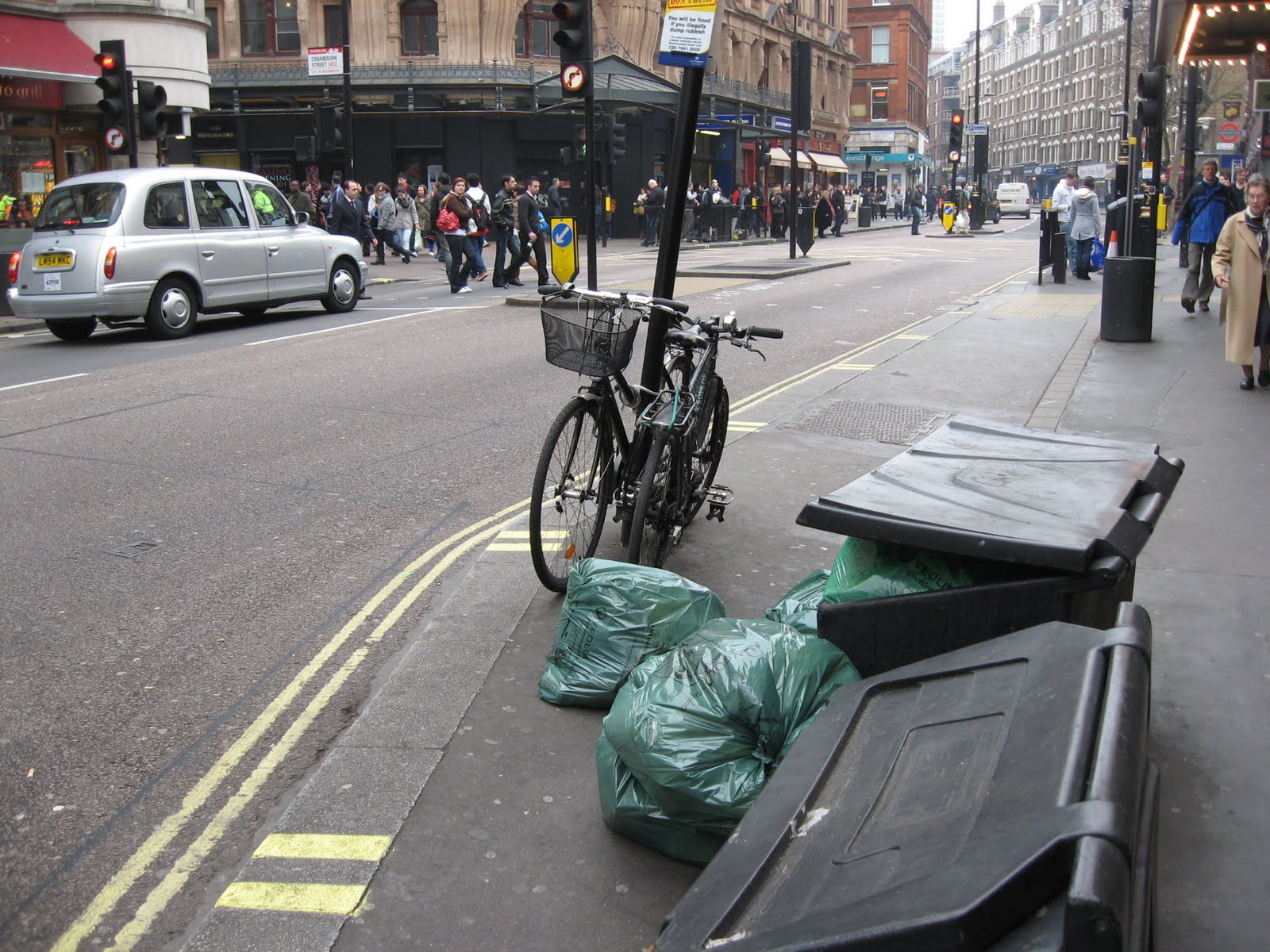
(Below) This is where I like to park my bike when I’m visiting the British Museum (handy for the rear entrance). Woops! All the stands have gone.

(Below) And these are the temporary cycle parking arrangements.

By the way the air pollution in London is nothing to do with it being a car-sick, car-sodden city. Nah, it’s all the fault of foreigners.
Sunday, 13 March 2011
Between a Cycle Superhighway and a Greenway

Question: If transferring from a Cycle Superhighway to an adjacent Greenway involves having to wait at five separate signalled crossings of dual carriageways, how long does it take a cyclist to travel 100 metres?
Answer: Long enough to make any Waltham Forest resident who cycles consider driving to their destination next time.
But while you are waiting there is plenty of time to photograph the local scenery. Can you spot the exhaust fumes coming out the car in the foreground? And the baby in the front passenger seat, acquiring the knowledge that this is how normal people get around London.
And talking of air pollution in London. Last year there was a grim final warning. Which, surprise surprise, turns out not to be final after all. Amazingly (doesn’t the EU recognise inertia, procrastination and evasion when it sees it?)
The UK has been given three more months to meet EU air quality standards in Greater London.
So what is the Mayor doing?
BoJo’s strategy amounts to
a dust suppressant trial, encouraging low and zero emission vehicles, taxi age limits and a hydrogen-fuelled bus service.
I’m shocked that ‘encouraging cycling’ isn’t in that awesome list.
Obviously curbing motor traffic and car dependency cannot possibly be considered.
And anyway there’s just no room to reallocate road space for cycling. As you can see here on the southbound A112 in Chingford.


It’s no different in central London. Here in Parliament Square there simply isn’t the space for a segregated cycle path. Those five lanes are needed for motor vehicles, especially black cabs. So, please, no unrealistic demands for what will never happen.

Tuesday, 7 December 2010
the cycling Mayor – latest news
Campaigners have threatened the Mayor with legal action if he goes ahead with plans to scrap the western extension of the congestion charge zone on Christmas Eve.
Members of Clean Air in London, a not-for-profit organisation behind a three-year campaign to improve the capital's air quality, have written to Boris Johnson claiming they will push for a judicial review if the removal of the extension proceeds as planned.
The letter claims the proposals are “unlawful” and threatens legal action over the zone's removal unless immediate measures are taken to tackle any damage to air quality from the expected 12 per cent rise in traffic.
CAL is being represented by law firm Harrison Grant, who were involved in the successful opposition to the proposed third runway at Heathrow.
EU law requires action be taken to ensure levels of dangerous airborne pollutants do not exceed World Health Organisation standards in outdoor public spaces.
A TfL report to the Mayor, obtained through a freedom of information request, predicts further three to four per cent rises for nitrous oxides and particulates in the western extension if regulations are removed.
Saturday, 13 November 2010
Money cut for pothole repairs
The blight of potholes and cracked pavements is likely to get worse after Boris Johnson froze funding for local road maintenance [in Greater London].
The Mayor is reducing the money boroughs get for small-scale projects, including street repairs, by 22 per cent.
The amount given to local authorities by Transport for London will fall from £169 million in 2009/10 to £132 million in 2013/14.
Green Assembly member Darren Johnson said: “Local authorities are being squeezed by a combination of cuts imposed directly by central government and cuts passed on by the Mayor. Some of this pain could have been avoided if Boris had kept the estimated £55 million generated by the western extension of the congestion charge.”
Monday, 1 November 2010
more 'Green Olympics' news!
The 2012 Olympics could fall short of its environmental pledges, the London Assembly has warned.
London 2012 pledged the Games will be the most sustainable in recent history. But the Going for Green report said a lack of electric vehicles, air pollution and renewable electricity targets were areas of concern.
Such a shame about the ‘electric vehicles’ which everyone knows are the only Green way of moving around a city like London.
Luckily the Olympic car parking projects (like this one and this one) and private road space for VIPs in limos (yes, that’s 2.5% or 1 in 40 of London's roads) will not be affected.
Onwards to the car-centric ‘Green Olympics’!
Wednesday, 27 October 2010
Filthy black cabs
The worst single type of vehicle for air pollution is the black cab. The cab is a London icon, but it's a vehicle that was designed in the last century when air pollution was less well-understood. Johnson has made a bad situation worse by cancelling the 6-monthly emissions check for black cabs.
However, he's now considering a new 'very low emission zone', which may apply to all vehicles, including black cabs. There wouldn't seem much point in it not applying to black cabs, given that they account for 35% of tailpipe emissions.
The fact is that the London taxi is the least 'green' transport mode. Each cab weighs around 2 tonnes, yet the typical load factor (number of passengers being carried) is around one passenger per cab. Consequently, emissions of all types (CO2, NOx, particulates) per passenger are an order of magnitude greater than other transport types except for private cars. In central London, black cabs account for around 70% of traffic.
Tuesday, 21 September 2010
Boris Johnson to poison London’s air for extra 3 months
London's mayor has confirmed that larger vans and minibuses will not be required to meet Low Emission Zone (LEZ) standards until January 2012.
These vehicles were originally due to be included in the LEZ from October 2010.
These vehicles were originally due to be included in the LEZ from October 2010.
Thursday, 16 September 2010
More global warming greenwash
In her first speech on climate change since taking office Caroline Spelman, the Environment Secretary, will speak about the need for Britain to adapt to rising temperatures.
“It is vital that we carry on working to drastically cut our greenhouse gas emissions to stop the problem getting any worse,” she will say.
One simple way of cutting emissions would be a national 50 mph speed limit, rigorously enforced, with massive penalties for ignoring it. It would also see a significant reduction in road crash fatalities. Naturally the ConDem petrolhead government has absolutely no intention of doing any such thing, even though lowering the speed limit to 50 mph would cut transportation-related CO2 emissions by 30 percent.
Wednesday, 28 July 2010
The pump don’t work ’cause the vandals took the handles
"This is an act of vandalism which puts the safety of motorists and our staff at risk.
"They've taken handles which we need to replace, which we're hoping to do as soon as possible".
"They've taken handles which we need to replace, which we're hoping to do as soon as possible".
Monday, 26 July 2010
Every day is Critical Mass for drivers

(Above) Markhouse Road E17. Don't try getting past these cars on a bike because you can't.
(Below) This woman is her gas guzzling jag quite deliberately cruised into the cyclists’ Advanced Stop Line on Great Newport Street WC2. It’s quite absurd that anyone should be allowed to drive a private car around this part of central London but London’s entire car-centric transport culture is built around pampering toxic anti-social car criminals like this, who are not even required to obey basic road traffic law.

(Below) This woman on Cranbourn Street WC2 is allowed to drive around central London in her sports car suppressing walking and cycling and poisoning the air. The pedestrian crossing is obstructed by a black cab.

Car sick Winchester

Winchester green campaigners have slated the city’s new transport plan as too weak and a recipe for a “deterioration of residential quality of life.”
Mr Gillham, a veteran FoE campaigner involved in Winchester transport issues for more than 30 years, said it did not address the challenges of climate change or sustainability and was too car-friendly.
“At the heart of the document is a fundamental blindness. The failure of imagination and the failure of will in Winchester is staggering.”
Mr Gillham was unhappy that the plan accepts that the car will carry on dominating people’s travel. He said there were towns in Europe of 150,000 people, four times the size of Winchester, where more journeys are made by bike than car and many places of 25,000 people that are almost car-free.
But car-sick Winchester is no different to car-sick York, car-sick Waltham Forest, car-sick London, or car-sick Britain. Britain is a coarse, reactionary society under the thumb of three political parties which all believe in pandering to petrolheads, with the worst transport planners in Europe, with a car supremacist Department for Transport which despises walking and cycling.
Everybody is in denial, including Britain’s two main cycling organisations who think that somehow things are going to get better.
Friday, 23 July 2010
Troublemaker in Shepherd’s Bush

Here are people in Shepherd’s Bush who are quite rightly campaigning for more congestion, toxic air pollution, and subsidised car dependency. Let’s face it, if drivers were made to pay for the social consequences of their addiction, most Londoners would end up being forced to walk, cycle or glide around in trams. Horrible. It would be like the worst parts of abroad.
I am sorry to say that the blogging world attracts malcontents and misfits and there is someone called Chris Underwood who lives in Shepherd’s Bush who writes
from my office in South London I have a view across Lambeth, the river and into Westminster. There are times when I can't actually see the towers of the City behind the wheel. The Gherkin and others disappear into grey haze under which, presumably, brokers and the like are breathing. Air pollution is linked to 3,000 deaths every year in London. Scary.
Personally I wanted the zone to succeed.
Footnote to a fellow blogger
I don’t know if you’ll ever read this, Chris, but for reasons you’ll understand in the context of your archives let me quietly draw your attention to this and this
Saturday, 17 July 2010
‘Green Car of the Year’ Crap

Last night saw Volkswagen win the What Car? magazine Green Car of the Year 2010 award for its Golf 1.6 TDI 105 Bluemotion 5 door. What Car? editor-in-chief Steve Fowler said: “The Golf Bluemotion does an enviable 74.3mpg and emits just 99g/km of CO2, which means it is exempt from road tax”
Road tax? Amazingly, all Britain’s motoring magazines still seem to use that meaningless phrase.
There is, of course, nothing remotely Green about the Golf 1.6 TDI 105 Bluemotion. In the first place these bogus Green claims sidestep the environmental costs of manufacturing cars. Secondly, this Golf runs on diesel, so although C02 emissions may be ‘low’ it still spews lethal particulates which kill people. Thirdly, it’s a killer machine, cynically manufactured to break the speed limit, with a top speed of 117 mph. Or as one carporn reviewer drools, it has
an aerodynamic body that slips through the air like a blowtorch through butter.
Another reviewer chuckles how
The car we drove had fewer than 2000 miles recorded and yet still it turned in 63.1mpg on a 100-mile trip down the M1, moving with mixed traffic between 50 and 75mph.
Breaking the speed limit is a bit of a larf innit. I don’t suppose anyone will be calculating how many pedestrians and cyclists will be run down and killed or injured in the next 12 months by drivers of this ‘environmentally friendly' death machine.
What else?
despite its family-friendly appearances, it's quite sporty to drive.
full airbags as standard
free road tax for life!
Boris Johnson promotes greater London car dependency and air pollution
The Mayor is proposing to cut the cost of motoring in central London by exempting yet more cars from the congestion charge:
Currently, hybrid and electric cars enter the congestion zone free, but this new move would allow diesel cars that have low CO2 emissions to also enter the zone free. However, campaigners believe this would compound London's air quality problems, as although modern diesel cars emit lower levels of CO2, they emit higher levels of oxides of nitrogen (NOx) and so exacerbate heart disease and respiratory illnesses such as asthma.
Ed Dearnley, policy officer at pollution campaigners Environmental Protection UK, wrote in his submission to the mayor's consultation: "The mayor's proposed 'greener vehicles discount' is misguided, effectively enabling many mass market diesel vehicles free entry to the charging area." The letter continues: "The primary aim for the congestion charge is to tackle congestion, so it is not in the interests of the scheme to exempt a large number of vehicles from having to pay the charge. The results are likely to be an increase in congestion, with knock-on negative impacts on journey times, air quality and ultimately emissions of carbon dioxide."
Monday, 12 July 2010
Noise pollution
People living in Borough High Street in south London were awoken at 1am by five workmen digging up the pavement with pneumatic drills for Thames Water mains replacement.
Oliver Watson, 34, a company director who lives above a bank, challenged the crew in the early hours last Thursday.
“The foreman said they had been granted a licence by Transport for London that allows them to work until 5am,” he said.
Oliver Watson, 34, a company director who lives above a bank, challenged the crew in the early hours last Thursday.
“The foreman said they had been granted a licence by Transport for London that allows them to work until 5am,” he said.
Wednesday, 7 July 2010
Walthamstow Land Rover Discovery driver seeks ‘to raise awareness’

This Walthamstow 4X4 driver believes she has been treated very badly. She is so outraged by the injustice that she contacted the local newspaper, drove back to the scene of her persecution, and posed by her Land Rover Discovery.
A SHOPPER was handed a £45 parking fine after being one minute late back to her car. Precious Davis said the three-hour time limit at Leyton Mills shopping centre could put shoppers off of going there.
Mrs Davis parked her Land Rover Discovery at the centre on May 21 and went to Asda and Fitness First. She was with her husband St. Clair and they arrived at 11.46am.
As they left the gym they saw a parking attendant standing at their car.
"We saw the car and the attendant standing by it but we didn't think anything of it," Mrs Davis said. "Then I saw the ticket. I said 'come on, it's a matter of seconds'."
Mrs Davis, 35, of College Road, Walthamstow, has appealed against the fine but it was not accepted by UK Parking Control Ltd.
She said the fine was "a bit over the top" and she wanted to raise awareness for other shoppers.
Mrs Davis’s sense of outrage I find quite interesting. Not because of her parking ticket story (it’s not a Council parking ticket but private enforcement done on behalf of whichever company owns Temple Mills retail park).
What I find interesting is what her car dependency tells us about the London Borough of Waltham Forest and its car-centric transport infrastructure.
The distance from Mrs Davis's home on College Road E17 9DF to the Temple Mills retail park E10 5NH is, by road, 1.934 miles.
This is a distance which could easily be walked or cycled. Mrs Davis prefers to drive there in her Land Rover Discovery.
The website Stop Urban 4X4s points out the dangers which vehicles like this pose to other road users:
The extra weight of 4x4s automatically makes them more of a danger to other road users when they are involved in a collision. From basic mechanics we know the kinetic energy of a vehicle, which needs to be dissipated in a crash, is proportional to its mass.
However, the unique problem with the off-roader shape is that this extra weight is combined with additional height. Higher bumpers and mismatched crumple zones lead to extra dangers to pedestrians, cyclists, people in smaller cars and the occupants of the big 4x4s themselves.
Indeed, it is argued that in collisions, 4X4s are
more than twice as lethal to pedestrians than normal cars.
There is also the issue of air pollution:
A heavier vehicle needs a bigger engine to achieve the same performance as a lighter car, which will in general produce more pollution per mile (including carbon dioxide, nitrous oxides, unburnt hydrocarbons and particulates).
Diesel models are popular among 4x4 owners because they are less thirsty. However, while diesel engines produce less carbon dioxide, they give out greater amounts of the other pollutants, which can make them even more harmful to the people around them.
However, even by 4X4 standards, the Land Rover Discovery is quite ‘thirsty’ with a combined fuel consumption figure of 17mpg. What’s more CO2 emissions for the Land Rover Discovery 4 are 244 g/km, which is very high.
Air pollution is a significant issue in the London Borough of Waltham Forest, as is health generally.
Life expectancy is lower than the average for London and the rest of the country
And
The Southern part of the Borough [which includes Mrs Davis’s home and her route to Temple Mills] is subject to higher levels of poor health, which has been associated with deprivation, poverty and overcrowding.
The poor are less likely to own a car and Waltham Forest has areas where the level of non-car owning households is surprisingly high (49 per cent in Hoe Street ward), alongside a growing proportion of households which own three or four cars.
The Council acknowledges that there is
Reliance on the private car as the main mode of transport, contributing to air pollution, greenhouse gas emissions and congestion; It appears that public transport is not being utilised to access employment opportunities and services and facilities.
What’s more
Studies have shown that some of the poorest air quality levels in Waltham Forest are adjacent the busiest roads in the borough and the whole borough has been declared an Air Quality Management Area.
I don’t know which route Mrs Davis takes when she drives her Land Rover Discovery the distance of less than two miles to Temple Mills, though the two obvious routes would be down Lea Bridge Road to Orient Way, or along High Road Leyton to Ruckholt Road. Either route involves using the strategic road network, and, as the Council recognises
Air pollution from the strategic road network is an issue across the Borough.
We now know that
POLLUTION kills 128 people every year in Waltham Forest, according to a new report.
The study, by the Institute of Occupational Medicine (IOM) and commissioned by London Mayor Boris Johnson, estimates that poor air quality is shortening life expectancy in the borough.
There are between five and seven deaths in each of the borough’s wards every 12 months
The figures for each ward in Waltham Forest can be found in the Report on estimation of mortality impacts of particulate air pollution in London.
But no one can really blame Mrs Davis for driving her Land Rover Discovery to Temple Mills. Every aspect of the local transport infrastructure encourages her to do so.
For a start, car parking on College Road is unrestricted and free. There are a number of 4X4s and luxury cars parked in this road on a regular basis. College Road happens to form part of a strategic cycle route but there can obviously be no question of displacing parking bays and substituting a cycle path. On the western side of College Road near the junction with Grove Road, the council has installed a dropped kerb for wheelchair users, but it has also deliberately ended the yellow line 'no parking' restriction before the dropped kerb, ensuring that a car may be parked lawfully across the dropped kerb. The needs of people wishing to park a car must come before the convenience of footway users with wheelchairs, prams, buggies or mobility scooters.
It is quicker for Mrs Davis to drive to Temple Mills than to walk or use a bus. Bus travel in Waltham Forest is a slow, cumbersome business. There are relatively few bus lanes and the roads are heavily congested by, well, people using cars. Whether or not it is quicker than cycling depends very much on the time of day and the traffic conditions.
If she cycled to Temple Mills she would find herself waiting up to six minutes to negotiate the signalled cycle crossing at the junction of Orient Way and the Eastway, because the phasing is set not to inconvenience motor traffic.
It is much safer for her to drive. In her large, fortress-like vehicle she is safe from other drivers and if she is involved in a crash, she is protected by air bags and many other safety features. If, instead, she cycled, she would find herself using a narrow cycle lane, mainly 1.5 metres wide, wedged between parking bays and overtaking heavy goods vehicles.
Driving to Temple Mills is also far more pleasant than cycling. There is nothing relaxing or enjoyable about cycling on the roads which Mrs Davis takes in her Land Rover Discovery. Apart from the danger and the high volumes of motor traffic, on the approach to Temple Mills the cycle path is neglected and overgrown and the signing hidden by vegetation or very misleading. There are a few back street routes which could be utilised but all of them involve cycling down roads lined on both sides with parked cars, a situation not conducive to safe or attractive cycling.
When Mrs Davis arrives at Temple Mills she can enjoy up to three hours free parking and park close to her destination (whereas if you are shopping on a bike there are, for example, no cycle stands by B&Q).
Of course there are social costs and consequences of Mrs Davis’s chosen travel mode but the Mayor of London has no interest in making her pay for them, and neither does the current government or the local council.
As far as infrastructure is concerned, both Transport for London and the London Borough of Waltham Forest are working hard to make life as good as it can be for Mrs Davis, by ‘easing traffic flow’. Among other things this involves introducing more and more one-way streets, converting more and more pavements for car parking, and moving cycle lanes to create parking bays.
Who can possibly blame Mrs Davis for preferring to drive a Land Rover Discovery for short distances than cycle in conditions like this? I certainly don’t.
It’s the infrastructure, stupid.
Subscribe to:
Posts (Atom)