Showing posts with label TfL. Show all posts
Showing posts with label TfL. Show all posts
Thursday, 25 October 2012
Gilbert Road Revisited
My recent post on the CTC and Gilbert Road has provoked an interesting response from a local Cambridge cyclist.
In its wider ramifications it strikes a chord, because it gets to the heart of where UK cycle campaigning currently is. Do you settle for minor improvements for existing vehicular cyclists (which is pretty much the history of UK cycle campaigning) or do you dig your heels in and demand the kind of Dutch infrastructure that really will bring about a massive rise in cycling’s modal share? (Of course a swathe of UK cycling opinion doesn’t accept that equation, which is itself another difficulty.)
This issue is pertinent to York, where cycling is stagnating, and to Bristol, and to Brent, and to Waltham Forest, and to everywhere else in the UK.
If radical change ever comes it may well come first in London but even though the ‘Go Dutch’ agenda commands wide support it appears that Transport for London has no serious intention of embracing it, as the examples of Blackfriars Bridge, the Bow roundabout, the Lambeth Bridge roundabout, Kings Cross, and now the Imax roundabout by Waterloo Station all demonstrate. It is too early to judge where the LCC’s ‘Go Dutch’ campaign is going but to my mind the signs don’t look good. And let’s also not forget the Vauxhall gyratory
Back to Gilbert Road and the Cambridge cycling blogger:
Lets put this into context. We're not a minority. Half of the populace ride a bike regularly, we account for upwards of a fifth of all journeys. We're mainstream. But we're also flatlining - stats for cycling in Cambridge have been similar since at least the '90s. So despite Gilbert Road cycle lanes, extended bike parks underneath City Centre car parks and cycle lanes on many roads, we're going nowhere. It is demonstrably true that cycling is making no advances in Cambridge, no matter how often Cambridge Cycling Campaign and the County Council smugly pat each other on the back because 22% or so of journeys are made by bike. Success such as would be measured by increasing share has not happened.
So I think we should ask a very obvious question. Who is the investment in cycling infrastructure for, and why do we make that investment? Is it for those who are already cycling, or is it for those who are not?

Sunday, 21 October 2012
Peter Hendy’s latest contribution to a toxic, uncivilised London

Oxford Street, choked with buses and taxis, and open to any motorist.
London’s top public transport chief has dismissed calls to rid Oxford Street of its “wall of red double deckers” saying it would require two vast “unacceptable and desecrating” bus stations to be built in the heart of the West End. The Mayor’s Transport Commissioner Peter Hendy was responding for the first time to growing demands from West End business that the volume of buses on London’s premier shopping street should be dramatically scaled back.
One proposal put forward is for east-west bus routes to stop at either end of Oxford Street with a shuttle service or tram running its one and a half mile length. But Mr Hendy said while the option had been looked at it had been decided that “having the huge bus station you would need at Marble Arch would completely desecrate a very important place to people in Britain.”
Of all the feeble excuses anyone can come up with allowing Oxford Street to remain a sewer for motor vehicles of all types, this has to be one of the feeblest.
In any case, if London was civilised for cycling far fewer people would need to use such a cumbersome, inefficient and high polluting mode as a bus.
London TravelWatch isn’t keen on getting rid of buses either, but, unlike toxic TfL, it at least puts forward a few modest reforms which would improve the situation:
‘We could improve efficiency of road space in this area by prioritising pedestrians and closing off more of the north and south side roads crossing Oxford Street, reducing the number of buses terminating in Oxford Street, and by restricting taxis. Taxis take up 37% of the road space, but only carry 1% of the passengers.

(Below) Pedestrian-friendly Oxford Circus.

Friday, 19 October 2012
Kings Cross: TfL procrastinates and stonewalls
It’s taken TfL 9 months to decide to hide behind their lawyers in responding to my request for information they hold on corporate manslaughter issues in Kings Cross.
There is no bigger public interest than understanding how they manage death and safety of life in their transport systems. So far TfL asserts that there is a bigger public interest in them keeping this secret. So I shall appeal this to the Information Commissioner.
Sunday, 14 October 2012
Boris Johnson, Transport for London and the killing of Hichame Bouadimi
Yesterday’s Guardian carried a long piece about the recent killing of five year old pedestrian Hichame Bouadimi on St George’s Road, Southwark, asking Why are road deaths in the UK on the rise again?
Unfortunately the journalist lets two major London agencies off the hook. One is the Metropolitan Police, which has always been institutionally car-supremacist. The Met is contemptuous of cyclists and pedestrians, and has only ever had a minimal interest in enforcing road traffic law. You can speed to your heart’s content in London, and chat away on your mobile phone, and your chances of being apprehended by a police officer are very, very remote. Nor is the Met at all interested in curbing the excesses of the out-of-control road haulage industry. The Met's slogan ‘Working Together For a Safer London’ seems like a calculated insult. Indeed
Drivers in London have a chance of being prosecuted once over a 50-year lifetime of driving.
This indicates that at present there is almost no chance of drivers who endanger cyclists (and others) being charged or prosecuted.
However, in this particular instance the primary blame for this latest tragedy rests firmly with Transport for London. It was the infrastructure that created the conditions for the violent death of this child. And TfL is resisting all efforts to change direction. It remains firmly committed to the ‘smoother traffic flow’ agenda.
But Boris Johnson should not be exempted from responsibility either. His signing-up to the LCC’s ‘Go Dutch’ agenda was plainly a desperate piece of opportunism when he was struck by a last-minute anxiety that he might, after all, lose to Ken Livingstone. In spite of all Johnson’s rhetoric nothing tangible has actually changed yet.
Take TfL’s proposals for the Lambeth Bridge roundabout, for example.
Southwark cycling blogger Charlie Holland even uncannily anticipated this latest fatality when back in January he denounced
the five-lane one-way motorstrosity that St George's Road has become
and remarked
Unfortunately TfL are using their time and energy on piddling interventions rather than on measures that will make a real difference.
This road, with three schools on one side and a park on the other, should swiftly be made two-way and cycle-friendly.
Charlie Holland has also written about the aftermath of this fatal collision here.
Monday, 8 October 2012
High Road Leytonstone: ‘more appealing’ than Dutch cycling infrastructure?

David Hembrow has reproduced a photograph used in a recent post of mine with a scene from a Dutch street, commenting: In the Netherlands, this is a technique used to civilize residential streets which are not busy through roads, which do not have a high number of motor vehicles passing through and which have a 30 km/h speed limit. In the UK the same thing is being done on busy through roads with higher speed limits and lots of traffic.
He shows lots of other Dutch examples here.
This provoked a comment:
I do not see what is wrong with the UK example you give in this post. Dare I say that the smooth tarmac of the UK cycle lane looks more appealing to me than the Dutch cobblestones... In addition, that is not a "parking lane" to the left of the picture, as the double yellow lines are also applicable within that section of road. This must therefore be just a loading bay. P.S. May I just clarify that I cycle a lot in both the UK and mainland Europe and generally feel that UK cycling infrastructure is very poor, often lethal. I just think that this particular photo, showing a well-maintained road and relatively wide cycle lane, doesn't really illustrate your point very well.
This is a good example of the confusion which can arise from a simple comparison of two apparently similar scenes. However before commenting on that, let me quickly say that the commenter is quite mistaken in asserting that the High Road Leytonstone photograph shows a loading bay. It doesn’t. Anyone can park in these bays and similar bays can be found all along this road, most of them filled with cars (as shown in the photo above). The reason why the bays shown in the photograph used by David Hembrow are empty is probably precisely because they aren’t outside shops.
Mixing with motor traffic on a Dutch street is quite different than it is on a London street. I realise in retrospect that my photo is unintentionally misleading because it makes it appear that High Road Leytonstone is a quiet street with little parking. In fact my photo just happened to be taken when there was a gap in the traffic. Luckily it was one of a sequence which I took while cycling up this street on a weekday and I reproduce the other ones below to put this isolated photo into context.
High Road Leytonstone is a road which links up with major London through routes and it carries huge volumes of motor traffic. One relatively small section is one-way with a contraflow lane for cyclists. This last feature is of course welcome but isolated infrastructure for cyclists is no use at all unless it forms part of a coherent and connected network. This remains the British disease: cycling infrastructure of any sort is always built on car-centric terms: as soon as it conflicts with the greater priority of ‘smooth traffic flow’ it notoriously comes to a sudden end. And, depressingly, Britain continues to go ever-backward. Over in South Gloucestershire they are seizing space from cyclists and pedestrians to benefit drivers.
In the London Borough of Waltham Forest things are no different, with the model used on Wood Street E17 (below) being rolled out across the borough. It is madness to build out the footway forcing cyclists closer to overtaking motor vehicles, especially buses and lorries, while at the same time creating new dangers from ‘dooring’. To do this is to make the conditions of vehicular cycling even worse and more off-putting than they were before. Here on Wood Street cyclists are pushed even closer to overtaking motor vehicles on a dangerous bend.

The recent ‘improvements’ on High Road Leystonstone are designed to encourage car use for short journeys, and they have been introduced with the enthusiastic collaboration of Transport for London. In some sections, including the one shown in the photograph used by David Hembrow, speeding is a problem. The speed limit is nominally 30 mph – far too high for a shopping street with residential housing mixed in – but some drivers are plainly exceeding this to a significant degree when the opportunity arises (such as early in the morning, or in the evening, or when traffic levels are low).
High Road Leytonstone is a major route which runs north-south from the Green Man Interchange (where the A114 and the A11/A1199 and the A113 connect with the A12, which connects the M11 motorway and North Circular Road (A406) with the Blackwall Tunnel) down to Stratford. Its ‘A’ road status was revoked when the A12 was reconfigured and pushed through Wanstead, Leytonstone and Leyton. Just looking at a map can give completely the false impression, since this section of the A12 is basically a motorway (albeit with a 50 mph limit) and cyclists are banned, while High Road Leytonstone, which lacks even the status of a ‘B’ road, carries massive volumes of motor traffic, far in excess of other local roads of equal status.
High Road Leytonstone is precisely the kind of direct, major route with high volume traffic which requires Dutch-style segregated cycle paths and where the space is available. It is a road which was once earmarked for total pedestrianisation – a project which was relentlessly subverted to result in the motor vehicle choked mess of today. Bear in mind that it is in a London borough where cycling’s modal share is, according to the most recent TfL figures, under one per cent. High Road Leytonstone has standard vehicular cycling infrastructure, including the classic template of the cycle lane leading into an Advanced Stop Line cycling reservoir. This cycling infrastructure notoriously lures the unwary cyclist into danger, especially when it concerns a lorry driver’s ‘blind spot’. Here is a recent instance which occurred on High Road Leytonstone, not far from where the photograph used by David Hembrow was taken.
The photographs below show conditions for cycling northward on High Road Leytonstone after the junction with Southwell Grove Road, a distance of less than half a mile. They were taken in a single continuous journey over a period of about three-four minutes. The first one was taken just before the scene shown in the photo used by David Hembrow, and the others show conditions beyond that location.
The reality is that the double yellow line ‘No Waiting At Any Time’ restrictions, designed to deter drivers from parking in the cycle lane, are regularly ignored, and that apart from the danger of ‘dooring’, drivers leaving their parking space rarely bother to consider if a cyclist is coming along, and block the cycle lane as they manoeuvre to slip into the line of traffic backed-up from the signalled junction at Church Lane. The final blurry photograph records what happens when a bus driver moves into the cycle lane in order to deposit passengers before reaching the bus stop.
In short, cycling up High Road Leytonstone is not a relaxing experience, and is fraught with danger and obstruction. The notion that conditions for cycling on this street are superior to those found on Dutch streets is not persuasive.


Saturday, 6 October 2012
Transport for London: killing London’s children
Residents demanded action to reduce speeding after a five-year-old boy was knocked down and killed by a lorry yards from his school. Scotland Yard said they believe the child was with his mother walking along St George’s Road in Elephant and Castle, south-east London, when he was in collision with the flat-bed truck at 3.45pm.
Residents complained of motorists regularly flouting the 30mph speed limit on the stretch of the road, part of a one-way system amid three schools. Laila Khory, who lives close to the crossing, said she had previously complained to Southwark Council and Transport for London about the problem. She said: “The cars just go so fast up and down this road - when they get a green outside Elephant and Castle they absolutely race down. It’s just not appropriate - this area is all schools.
Victoria Line closures: the lies of Transport for London
Back in March 2012, London Transport was telling us that the weekend shutdown on the 6th and 7th of May would mark the very last of a long series of weekend tube closures on the Victoria Line.
But it wasn’t. There was an all day closure on 14 July: LT say that this will be the absolute, definite, no-kidding-honest-guv’nor last full closure of the Victoria line, with its engineers using the closure to “make the final tweaks to our new, upgraded signalling system.”
Transport for London has now announced that the Victoria Line will be closed between Brixton and Seven Sisters (i.e. almost the entire line) for the weekend of 13 and 14 October, and again, between Brixton and Highbury & Islington (i.e. almost the entire line) all the following weekend, 20 and 21 October.
But as that's not a "full closure" I suppose TfL could claim to have kept their promise. Just not in the way anyone but a lawyer would have expected.
Saturday, 29 September 2012
Brick Lane Blues
Back in February At War With The Motorist noticed that
Tower Hamlets council, with £300,000 from TfL, have announced that in the next few weeks they will be replacing the bricks of Brick Lane with a standard issue asphalt carriageway.
Their rationale was
to “help to distinguish space for pedestrians from traffic”. That is, this is an explicitly anti-shared space move, intended, perhaps, to put pedestrians back in their place.
AWWTM commented
Brick Lane is a far more suitable candidate for shared space than most of the high-profile schemes. It is already a narrow single-lane one-way street with a high pedestrian to vehicle movement ratio — a high place status, in the jargon, and little importance as a transport route.
Brick Lane is exactly the kind of narrow city street — important place for people but unsuitable for and unimportant as a transport route — where shared surfaces could be beneficial.
So let’s see how this expensive “improvement” worked out.
Oh, yes. Marvellous. Very Transport for London. Putting the car-sickness back into the heart of things.


Wednesday, 26 September 2012
Transport for London, where safety is paramount
A bicycle is a very dangerous object. If you see one which has fallen over on no account attempt to set it upright again.
A Transport for London spokesman said: “This bike was locked to the railings on an access path and had fallen over and was causing a safety hazard. As such it had to be moved immediately and we were left with little choice but to cut the lock.
Transport for London is altogether more relaxed about the safety of cyclists on London’s roads, where the minimum London cycle safety standards have simply not been applied and where cycling casualties are increasing.
There are
good reasons to adopt a target to reduce the rate of cycling casualties per distance travelled, and similar targets for other modes. But TfL have decided against such a target; in fact they have decided against having any target of any kind to reduce cycling casualties.
Tuesday, 25 September 2012
Advanced Stop Lines and cycling safety

Photo: The Argus. The aftermath of a collision which apparently involved a left-turning vehicle and a cyclist.
Yesterday the car-centric Department for Transport announced that it was still determined to shun best practice at road junctions and was instead recommending the usual stale vehicular cycling solutions which will predictably result in cyclists being killed and maimed and which will do absolutely nothing to bring about a mass cycling culture in the UK:
The Department for Transport has published today a review of design solutions to protect cyclists at road junctions. It found that the four leading methods of protecting cyclists were creating advanced stop lines for cyclists at traffic lights; painting coloured cycle lanes across road junctions; straightening staggered road crossings; and changing traffic priority at crossings to give right of way to cyclists crossing roads on cycle lanes. The study concluded that it would be cost-effective to launch trials of coloured cycle lanes through junctions. It found that allowing cyclists to turn left at red lights was among the worst possible solutions.
The bit about ‘changing traffic priority at crossings to give right of way to cyclists’ sounds on the face of it quite progressive but it’s ambiguously worded and I think all they are referring to is a theoretical right of way embodied in painted markings on the carriageway rather than an infrastructural one such as dedicated cyclists-only crossing phases or absolute priority for cycle paths at all side roads.
All the rest of these ‘design solutions’ are very obvious vehicular cycling crap with decades of failure embedded in their implementation. For example, some years ago the London Borough of Waltham Forest went through a coloured-cycle-lanes-through-junctions period, and these crap lanes did absolutely nothing for modal share because they provided no protection from turning or overtaking motor vehicles. (Though to be fair they were very useful for blind cyclists.)
The DfT ought to be setting an example but remains ideologically committed to prioritising motor vehicle infrastructure and the speed and convenience of drivers. I must say I find it rather weird to read the London Assembly's Transport Committee chair Caroline Pidgeon saying things like “The Department for Transport must allow TfL to catch up with best international practice”. The DfT is wilfully indifferent to best international practice, but then Ms. Pidgeon herself seems more than a little confused about what it amounts to. Trixi mirrors, training for lorry drivers, and poxy little lights for cyclists giving them a few seconds start at the lights are not best practice and form no part of Dutch cycling culture. And when I read people talking about segregated cycle tracks “where possible” my heart sinks, because there is no shortage of people who can come up with excuses why it can’t be done (roads too narrow, utilities wouldn’t like it, deliveries to shops, bus stops, would get in the way of car parking, just not possible).
In any case
A year on from the Kings Cross fatality we still have no understanding of why or how TfL makes decisions and takes actions when it is warned of danger to cyclists on roads it has designed, nor how it takes a measured responsible risk assessment when reopening a road following a severe cycle accident.
And now let’s see how “protecting cyclists [by] creating advanced stop lines for cyclists at traffic lights” works out in York, which as we know from the CTC is the safest place in Britain to cycle [see previous post, below]. Here (below) we see a woman cycling east in the cycle lane on Bootham, approaching the junction with Gillygate. A massive left-turning heavy goods vehicle is waiting just behind the Advanced Stop Line (ASL) for the lights to change.

What happens next is that the woman undertakes this massive lorry and then positions herself ahead of the ASL. She has done something highly dangerous – undertake a lorry indicating a left turn – and she has acted unlawfully by moving beyond the ASL.

The point, of course, is that the infrastructure conditioned her behaviour. In Britain’s congested towns and cities it is quite common to encounter this kind of cycling infrastructure – a narrow cycle lane leading up to an ASL. Cyclists quite naturally undertake the line of stationary vehicles waiting for the lights to change, especially here on Bootham where, as a testament to York Council’s long history of discouraging walking and cycling, the vehicles can sometimes stretch all the way back to Clifton Green.
The danger point comes if the lights change while the cyclist is undertaking and hasn’t yet reached the ASL (always assuming that the ASL isn’t full of vehicles, as they so often are – a consequence of the prejudice against enforcement which informs all UK policing, which is institutionally car supremacist). This is where so many cyclists get caught out, alongside left turning vehicles at junctions. But having successfully negotiated the undertake it's only sensible to go beyond the ASL, because that may well put you slap bang in the driver's blind spot. Cyclists respond to perceived hazards in classically Darwinian fashion. Rule-breaking ensures survival, however much this may distress the 'winning respect for cyclists' brigade.
The solution, as the Dutch understand, is to separate cyclists from turning vehicles at junctions, either by separate signals or by cycle paths physically segregated from the carriageway.
Because the cyclist went beyond the ASL she ensured she was probably not in the driver’s blind spot, and when the lights changed she went on her way unharmed. It worked for a solitary cyclist, but imagine the situation if there were twenty or thirty cyclists queueing at this junction, some going straight ahead and coming into conflict with left-turning vehicles. Look at the space required by this driver to turn left into Gillygate, a two-way street:

The DfT’s solutions for safer cycling at junctions are risible and inept.
Conditions for York cyclists are no better on the two other roads leading to this junction, which also have an ASL.
This is the narrow cycle lane on Gillygate, approaching the junction shown above. Not really cycling-friendly, is it?

Here we see a woman on a bicycle on St Leonard’s Place, cycling north towards the same junction. She is forced to a stop by a stationary bendy-bus (caught up in the line of stationary vehicles backed up from the traffic lights at the distant junction) which, wisely, she chooses not to undertake.
If you want to know why York is a failed cycling city, why cycling is stagnating there, and why the CTC’s claims for York are delusional and idiotic, look no further, dear reader, than the conditions shown in these photographs.


Friday, 14 September 2012
‘Smoother traffic flow’ is working!
Yes, getting rid of pedestrian crossings, reducing the times that pedestrians get to cross on those crossings that still exist, and ensuring that crap cycle lanes never in any way intrude on the urgent needs of London car drivers, is paying off!
Question No: 2315 / 2012
Caroline Pidgeon
In TfL’s surface transport panel papers from July 3rd Average Traffic speeds are reported as having increased during period 2 from 17.4 mph to 17.91 mph. Do you welcome this increase in average speed?
[Ed. This is what grammarians call a rhetorical question.]
There are also a number of very cogent cycling questions for the Mayor listed here (unfortunately the questions are not grouped according to subject, so you have to go through the whole bloody lot if you are interested in cycling matters).
There’s a killer statistical question from Richard Tracey ( No: 2512 ) asking for a breakdown of travel modes used in accessing the Olympic Park. (OK, so he probably has an ulterior motive but it's a good question.)
Len Duvall also asks for detail on how “Going Dutch” will feed into the design of CS5 from Victoria to Lewisham. (No: 2670).
Wednesday, 5 September 2012
Sunday, 2 September 2012
Cyclophobia on Primrose Hill

Apart from all the other ironies associated with Transport for London’s cycling propaganda, not least is the reality that the kind of scenes regularly portrayed – smiley cyclists in London parks – are actually places where cycling is usually banned or rendered unattractive through circuitous routes or CYCLISTS DISMOUNT sections.
Like here, for example, where all cycling is banned.

The famous London park known as Primrose Hill, where as you can see there simply isn’t space for cycle paths.
Andreas: I’ve recently spotted signs in Primrose Hill, stating that plain clothes officers were patrolling the park and would be handing out fines for any cyclists pedalling through the park.
Perhaps "officers" refers to park keepers, or possibly it means that the Met (which has massively reduced its enforcement of traffic law) will use plain-clothes officers to crack down on cyclists. The Met would never dream of using plain-clothes officers or unmarked police vehicles to crack down on lawless drivers, and if it did you can be certain there would be a media frenzy-froth about the abuse of the civil rights of motorists. Either way it's a reminder of what a cyclophobic society Britain has become.
In any case it’s farcical. Primrose Hill is a glaring example of the pathetic lack of influence which London cycle campaigning has had over the years. There is no reason at all why Primrose Hill should not have dedicated cycle paths running across it, and it’s scandalous that it doesn’t. But has any cycle campaign organisation ever held a single protest over this? If it has I must have missed it.
There’s even a (rather good) song which mentions naughty illegal cycling on Primrose Hill.
Monday, 20 August 2012
Why do more people not involve themselves in this very safe activity?

On Friday I saw a man jump off a high building into a London street. This is a perfectly harmless activity and I would urge you all to give it a go.
I saw with my own eyes how the man in the pink suit jumped off the roof and landed quite safely in the street below.
Incredibly, many people have got the totally mistaken idea that jumping off the top of a building is dangerous. In fact anyone can do it.
How many times do I have to keep saying this? JUMPING OFF THE TOP OF A BUILDING INTO THE STREET BELOW IS VERY, VERY SAFE.
I believe that not enough is being done to encourage jumping off the tops of buildings. There are two ways we can tackle this, and I am confident that with the right approach we can get one Londoner in twenty jumping off the top of buildings by the year 2025.
What we need first of all is a promotional campaign to encourage jumping. We need big street posters with messages like CATCH UP WITH THE JUMPING.
We need photographs of a young slim model smiling broadly and with her long hair blowing out behind her as she plummets to the ground, alongside the simple word FREEDOM.
The posters need to be accompanied by a campaign to educate people who have the totally mistaken idea that jumping off a roof is dangerous. The best way of changing people’s minds is through statistics, and statistics prove that it is perfectly safe to jump off high buildings.
FACT: The figures show that every year more people are injured in Britain as a result of gardening than from jumping off a roof. This totally proves how SAFE jumping off a roof is.
But let’s face it, promotion and education are not in themselves enough. We need to address the fears of novices who say that they would be happy to jump off a roof but they think it’s just too dangerous. The solution here is TRAINING.
No one should be allowed to jump off a roof without instruction from an accredited trainer. What we need is free roof jumping training, financed by local councils. With expert training those irrational fears can be conquered and before long the small number of existing roof jumpers will be joined by their partners and children. (However please get the written approval of social services before allowing your child to jump off a roof, as some ignorant and prejudiced people may report you for putting your child at risk. Incredibly, and very disappointingly, some schools actually ban children from jumping off their school roofs.) There are already encouraging signs that a “roof jumping revolution” is underway.
PLEASE NOTE this blog post is not intended to promote self harm. If you are distressed or upset in any way by this blog post please seek medical advice.
CAUTION. Do NOT confuse a harmless practice like roof jumping with others which may appear risk-free but are in fact extremely hazardous.
UNDER NO CIRCUMSTANCES ATTEMPT CYCLING AS THIS IS HIGHLY DANGEROUS.
FOOTNOTES
1: The man in the pink suit jumped off the roof into Brushfield Street E1. Apparently he was Robbie Williams’s stunt double and was involved in making a rock video for a forthcoming single called ‘Vertigo’.


2: The original plan was to end this post with a Robbie Williams video, but out of respect for our readers’ good taste in music this idea has been dropped. Instead here is The London Cycling Song, suitable for playing at all cycle campaign group meetings throughout Greater London.
Saturday, 11 August 2012
Olympic sprint and hurdles events for everyone
As the Olympics draw to a close please remember that Olympic sprint and hurdles events are occurring all over London and participation remains open to all. If you fancy your skills at jumping, then just go for a stroll and try out one of these.

Once you have mastered the art of jumping over an obstacle, the next thing is to attempt sprinting. Central London contains numerous combined hurdling and sprint tracks which are free for the public to use.
Have fun finding out if you can get to the other side of the road without being run down by an Olympic BMW in the Games Lane.
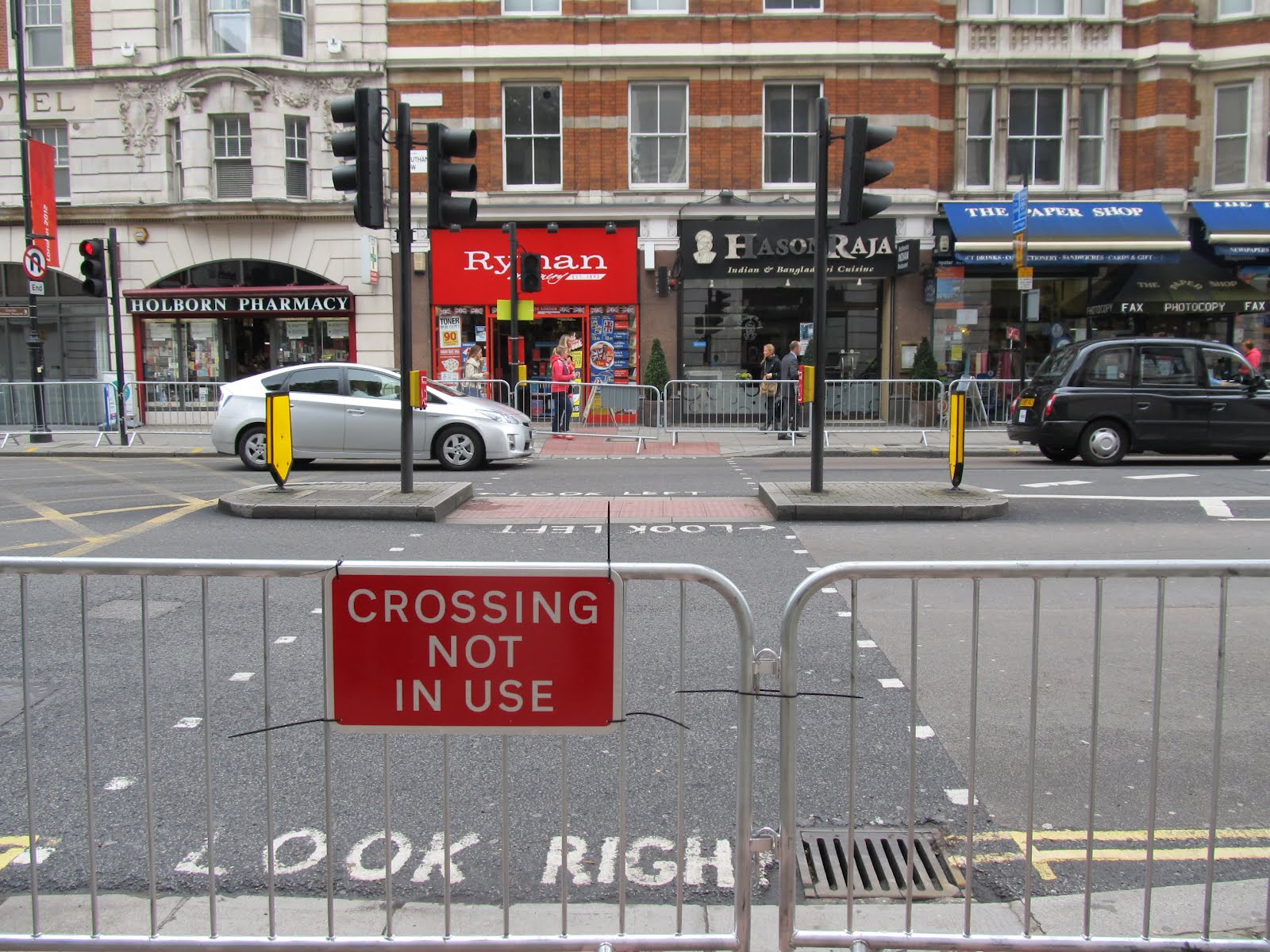
For added fun, bring along a suitcase. Here we see two visitors to London who are attempting the gruelling Parliament Square “crossing the road” track (CAUTION: suitable only for athletes in the peak of condition). They have successfully made it to a traffic island, but already their chances of a gold are fading rapidly as, hopelessly confused, they look in completely the wrong direction!

Here they have corrected their error. But what they haven’t spotted is that there is a surprise hurdle directly ahead of them just as they think they’ve finally managed to cross the road!

These foreign visitors (below) make the same discovery. Watch as they run shrieking from multiple lanes of approaching motor vehicles, in the final round of the gruelling and highly dangerous “safety in numbers” event.

From the Bow Roundabout comes this particularly impressive piece of film of a gold medal winner:
note that not only are there no pedestrian lights, but on this crossing there isn't even a dropped kerb, so she has to lift up the buggy whilst sprinting across 3 lanes of traffic with no signalling and a small child in tow.
Finally, let’s give credit where credit is due and thank Ben Plowden for making all this possible.
As he modestly puts it, Prior to working at TfL, Ben was one of the country’s leading environmental campaigners.
Ben was ahead of his time, arguing as long as 2000 that To see why walking and cycling are central to solving Britain's transport crisis, we should look to the Netherlands.
Yes, until he wheedled his way into TfL our Ben would gush about iconic cities which set an example:
Safe and direct pedestrian crossings at every junction make walking quick and easy for people in a hurry. For those with time to spare, benches, street cafes and pocket parks provide places for reflection and relaxation. The traffic is slow and light. The pavements are wide and clean. There is not a guard railing to be seen. No wonder the smart money is pouring into Portland.
Interesting that Ben was interested in smart money, as his annual salary at TfL is reported to be £170,000.
Yes,
Ben Plowden is TfL's "Director of Better Routes and Places". His previous title at TfL was "Director of Integrated Programme Delivery", which job involved "bringing together key projects including walking and cycling, road safety and smarter travel".
People in public life often make political transitions, for example, MPs who "cross the floor" of the House of Commons. But few can have made such a discreditable transition as Ben Plowden. For he was the first Director of the Pedestrians Association (now Living Streets), heading that organisation from 1997 to 2002. In 2001 he said "We are trying to make streets places people can enjoy." Presumably by "people" he did not mean "motorists who want to drive at speed". Carlton Reid has highlighted some of the other things Plowden said when he was in that job.
It’s no surprise at all that Ben Plowden now devotes his time to spin and blather.
Thursday, 9 August 2012
A View from the Games Lane

I admit it. I broke the law. I cycled in an official games lane, meriting a fine of £130. But as there was no one around to enforce the law I escaped punishment.
Another shocking example of a lawless cyclist, and another reason why cyclists should pay vehicle excise duty, be registered and be forced to display number plates, have compulsory insurance, and be made to wear helmets?
No.
Ladies and gentlemen of the jury, it was the infrastructure that was to blame.
The games lane in question is on the westbound A106. This provides a direct route between Leyton and Hackney Wick. It’s basically a three-lane motorway and only hardcore commuter cyclists use this route. It is not a route for leisure or utility cycling. Where it isn’t the equivalent of an urban motorway, it’s a hellish gyratory (the gyratory component is formed of Alexandra Road and Ruckholt Road in Leyton, where cyclists can enjoy classic Waltham Forest crap door zone cycle lanes) and then further west Ruckholt Road morphs into Eastway. This is what happens when you cycle down Eastway towards Hackney. At first you are on a three lane urban freeway:

Then the slow lane turns into a left turn only lane. If you are continuing west towards Hackney you need to get into the middle lane. But the middle lane is an official Games Lane:


You are therefore expected to get into the fast lane. Which is a bit tricky when you are being overtaken by vehicles travelling at high speeds. Even the driver of the car in front of me found themself trapped in the Games Lane:

However, at the next junction, if the lights are at red, the ASL allows the cyclist to pull over into the fast lane. You can then “take the road” and obstruct a long line of motor vehicles by cycling ahead of them. The infrastructure requires you to do this as far as the junction with the A12 in the distance, where the latest London cycling fatality occurred. But not to worry, since London drivers are famously tolerant of being stuck behind a cyclist.

I didn’t see any other cyclists on my white knuckle ride down Eastway. This is a shame, since TfL’s new cycle promotion poster brilliantly captures the bucolic idyll of cycling in London. And it’s quite truthful, too, since the fast lane of the Eastway does indeed allow drivers to “Catch up with the bicycle”. Strangely, the cheery greetings of drivers behind you all begin with the letter "f" yet the word they articulate isn't freedom.

Tuesday, 7 August 2012
Transport for London’s latest insult to London’s cyclists

Reach for a sick bag, dear reader, because you’ll need one when you read Transport for London’s response to the latest killing of a cyclist, who died a hideous and violent death as a consequence of its “smoother traffic flow” agenda.
The best memorial poor Daniel Harris could have is a complete re-design of the junction where he died. The LCC warned of the dangers long ago and was disregarded.
The bicycle campaign [London Cycling Campaign], whose group represents about 11,000 riders across the city, said in a statement that the scene of Harris' death is "a location that we've been warning the Olympic authorities about for years."
"This crash confirms our worst fears," the group said. The intersection, Cavenett said, is a "confusing" mixing bowl that funnels traffic in six directions near a restricted bus and car entry to the Olympic Park complex.
Transport for London said it was addressing the campaign's concerns and announced at least six signs would be installed along the approach to the junction, warning cyclists and pedestrians of the potential traffic hazards.

Wednesday, 3 August 2011
a death site revisited: Vernon Place


Vernon Place, eastbound. Three lanes wide at the junction with Southampton Row. Absurdly, the third ‘fast lane’ can legitimately be used for drivers going straight ahead as well as making a right turn. This generates conflict with right-turning cyclists, especially those unable to get into the fast lane because of speeding traffic or obstruction of the Advanced Stop Line (ASL).
Spot the cyclist in the second photo. You can’t, though there is one present here in this three-lane-wide wedge of packed motor vehicles
Vernon Place (London WC1) is a junction where two women cyclists have been killed in recent years, one in 2008 by a left-turning lorry, another in 2009 by a right-turning bus. I blogged about the last fatality here and there was more commentary by Olaf Storbeck here.
More recently I blogged about conditions for cyclists as you approach the junction
(Below) I photographed the ASL after the lights had gone to red and waited to see if any drivers would flout it.

(Below) By a strange quirk of fate the first vehicle which came along was a number 98 bus – the same service which killed Dorothy Elder. The light had been red for some time before this bus arrived, and the driver had no excuse at all for doing what he did, which was to wilfully and deliberately drive into the ASL reservoir for cyclists.

(Below) While he was waiting at the lights the driver of this bus switched his attention from driving to reading some papers in his cab. My photo captures the moment that the lights change, with the driver still staring down at whatever he was reading, oblivious to what was going on around him. He didn’t even notice me taking photographs of him. In other words, Metroline drivers of number 98 buses are still driving in a criminal and reckless way at a site where one of this company’s drivers killed a cyclist.
Olaf Storbeck also wrote about the death of cyclist Jayne Helliwell, killed nearby by a bus driver on Oxford Street remarking I urge Metroline and TfL to take responsibility for Jayne’s death. Fat chance, I’m afraid.

Ironically, the next sight I observed was a number 8 bus in the fast lane coming into conflict with a right-turning cyclist (below). The number 8 bus was going straight ahead. The right-turning cyclist had evidently not had the confidence to get over to the right when approaching the junction. This was potentially another fatal collision scenario. However, it happened in broad daylight (whereas the two fatalities occurred here during the hours of darkness) and the bus driver was attentive to the cyclist’s manoeuvre, and braked to allow the cyclist to pass in front. This episode simply underlines what a catastrophically dangerous junction this is for cyclists. The only safe solution here is to separate cyclists from motor vehicles on all four arms of the junction – segregation is perfectly viable in terms of available road space – and to give cyclists a dedicated all green phase. Needless to say TfL isn’t thinking in such terms; sadly, neither are many cycling campaigners, who prefer to focus on confidence building and cycle training, conspicuity, and changing driver behaviour through education, enforcement or new legislation.

Monday, 1 August 2011
Harry Potter and the TfL cycling commercial
Recently I went from Walthamstow to Woodford (which is in the adjacent London Borough of Redbridge) two days running. The first time I went on my own, by bike. The next day I drove there, this time with someone else, to see the new Harry Potter movie.
My destinations were almost identical both days running. In each case it took the same time to get there – fifteen minutes. Cycling offered a more direct route, but that direct route could have been much quicker if the right infrastructure was there. What infrastructure there was for cyclists was subjectively dangerous, objectively dangerous, and substandard. An example.
This is Woodford New Road (A104) at Waterworks Corner (named after an underground reservoir). Here the carriageway is five lanes wide. The cycling route to Woodford is on the other side of the road.

There is no crossing for cyclists and pedestrians here, other than through circuitous underpasses. Drivers get fast, smooth, direct routes but cyclists and pedestrians are marginalised. You have to go via that area of greenery in the distance.
The distance from here to Grove Hill E18, a cul de sac which offers cyclists a direct route into the shopping centre, is, as the crow flies, about 100 metres. But cyclists and pedestrians are diverted under the roundabout. You have to go through a minimum of two underpasses, no matter what your destination. The signing is poor. This is what it’s like to cycle from the west side of Woodford New Road through the Waterworks roundabout underpass to Grove Hill. It takes two minutes – a long time to travel a distance of about 100 metres. Bear in mind that this is a ‘shared use’ route for two-way cycling and walking. Not surprisingly, no other cyclists or pedestrians are encountered on this lonely, out-of-the-way route. The subways are covered in graffiti, not all the lighting panels are working, the lighting column on the route is burning brightly in the daytime (which probably means the timer is wrong and it will be out during the hours of darkness). Because this is not a high definition film you can’t really appreciate the cracked surfaces or the litter or the slimy mud in the second subway.
Cycling infrastructure like this is always very poorly maintained. Indeed, just before entering the labyrinth inside the roundabout, the ‘shared use’ footway on Woodford New Road has this dangerous surface – a drain covering which has been shattered, probably by a lorry driving over the footway. Broken infrastructure like this often remains in this condition for months.

Which brings me to Harry Potter and TfL. The movie was preceded by half an hour of commercials and trailers. One of the first commercials was from TfL. It showed a variety of smiley-smiley cyclists radiantly happy as they pedalled through the cycling-friendly streets of London.

But as we know from Rob Ainsley (who took the pic above), the police close streets to motor vehicles to allow TfL to make their cycling commercials. These kind of adverts cost around a quarter of a million pounds and involve paying minor celebrities like Edith Bowman (no, me neither) five grand for a day posing on a bike. The message being: hey, it’s cool to ride a bike!
No it isn’t. It’s often stressful, inconvenient and dangerous riding a bicycle in London. It depends on your journey, of course - but a lot of the time it makes much more sense driving a car. Driving to Woodford was fast, convenient, safe and stress-free. Because I know the area very well I was able to find free parking close to the cinema. The only minor annoyance was encountering temporary traffic lights on Woodford High Road because of roadworks. No problem – on the way back I simply rat-runned through the residential streets, avoiding the lights. Everything in London is geared to making short-cuts by car as easy as possible, and it’s just the same everywhere else.
By the way, the TfL cycling commercial was only in two dimensions. The best ads were in 3-D. They included a cool Audi commercial (Audis are FAST and VERY SAFE was the message), a boy’s racing car game, and a trailer for CARS 2. By which time everyone in the audience had, I’m sure, forgotten all about that cycling-is-fun stuff.
My destinations were almost identical both days running. In each case it took the same time to get there – fifteen minutes. Cycling offered a more direct route, but that direct route could have been much quicker if the right infrastructure was there. What infrastructure there was for cyclists was subjectively dangerous, objectively dangerous, and substandard. An example.
This is Woodford New Road (A104) at Waterworks Corner (named after an underground reservoir). Here the carriageway is five lanes wide. The cycling route to Woodford is on the other side of the road.

There is no crossing for cyclists and pedestrians here, other than through circuitous underpasses. Drivers get fast, smooth, direct routes but cyclists and pedestrians are marginalised. You have to go via that area of greenery in the distance.
The distance from here to Grove Hill E18, a cul de sac which offers cyclists a direct route into the shopping centre, is, as the crow flies, about 100 metres. But cyclists and pedestrians are diverted under the roundabout. You have to go through a minimum of two underpasses, no matter what your destination. The signing is poor. This is what it’s like to cycle from the west side of Woodford New Road through the Waterworks roundabout underpass to Grove Hill. It takes two minutes – a long time to travel a distance of about 100 metres. Bear in mind that this is a ‘shared use’ route for two-way cycling and walking. Not surprisingly, no other cyclists or pedestrians are encountered on this lonely, out-of-the-way route. The subways are covered in graffiti, not all the lighting panels are working, the lighting column on the route is burning brightly in the daytime (which probably means the timer is wrong and it will be out during the hours of darkness). Because this is not a high definition film you can’t really appreciate the cracked surfaces or the litter or the slimy mud in the second subway.
Cycling infrastructure like this is always very poorly maintained. Indeed, just before entering the labyrinth inside the roundabout, the ‘shared use’ footway on Woodford New Road has this dangerous surface – a drain covering which has been shattered, probably by a lorry driving over the footway. Broken infrastructure like this often remains in this condition for months.

Which brings me to Harry Potter and TfL. The movie was preceded by half an hour of commercials and trailers. One of the first commercials was from TfL. It showed a variety of smiley-smiley cyclists radiantly happy as they pedalled through the cycling-friendly streets of London.

But as we know from Rob Ainsley (who took the pic above), the police close streets to motor vehicles to allow TfL to make their cycling commercials. These kind of adverts cost around a quarter of a million pounds and involve paying minor celebrities like Edith Bowman (no, me neither) five grand for a day posing on a bike. The message being: hey, it’s cool to ride a bike!
No it isn’t. It’s often stressful, inconvenient and dangerous riding a bicycle in London. It depends on your journey, of course - but a lot of the time it makes much more sense driving a car. Driving to Woodford was fast, convenient, safe and stress-free. Because I know the area very well I was able to find free parking close to the cinema. The only minor annoyance was encountering temporary traffic lights on Woodford High Road because of roadworks. No problem – on the way back I simply rat-runned through the residential streets, avoiding the lights. Everything in London is geared to making short-cuts by car as easy as possible, and it’s just the same everywhere else.
By the way, the TfL cycling commercial was only in two dimensions. The best ads were in 3-D. They included a cool Audi commercial (Audis are FAST and VERY SAFE was the message), a boy’s racing car game, and a trailer for CARS 2. By which time everyone in the audience had, I’m sure, forgotten all about that cycling-is-fun stuff.
Sunday, 31 July 2011
Blackfriars Bridge protest
Spot the speeding driver caught on camera before the protest started.
A full report on the demo from Road cc here and I Bike London here. More footage here:
A full report on the demo from Road cc here and I Bike London here. More footage here:
Subscribe to:
Posts (Atom)