Showing posts with label poor design. Show all posts

Monday, 29 October 2012

car-centric junction design


You can find junction design like this all over Britain. Part of the verge has been appropriated, rounded-off, and re-allocated as carriageway for the benefit of vehicles turning into, and emerging from, a side road. Pedestrians are sent on a diversion.


The purpose of this design may benefit larger vehicles, which require more space to turn, but it also encourages car drivers and others to approach or exit the junction faster than they might otherwise have done. This is bad for cyclists, since there is a greater risk of a ‘left hook’ (i.e. a driver overtaking and then immediately turning left) and also encourages some drivers to exit the junction in the face of an oncoming cyclist.

But it is also bad for pedestrians. It ignores the natural desire line. To be diverted for a distance of some ten metres up a side road in order to cross (with another ten metres to return to the original route) is inconvenient and adds to journey length and time. But it also greatly increases the chances of a pedestrian being knocked down while crossing, because this design removes the pedestrian from the sight line of drivers approaching from the rear. This creates the classic scenario for the speeding driver to assert that the pedestrian “just came out of nowhere”.


How could this design be improved?

The original sharp T-junction design could be restored, forcing drivers to turn in and out of the junction at much slower speeds and with much greater care. The footway needs to be reinstated to what must surely once have been its original route, directly across the junction, with no diversion.

Perhaps a better solution would be to keep the design but continue the footway across the junction in a straight line on a raised table. But for that to work there would need to be markings on the carriageway that gave pedestrians absolute priority.

Either way, existing junction design like this, which is found everywhere in the U.K., illustrates how fundamentally car-centric and hostile to walking and cycling street design in our society is. And most people won’t even notice; design like this seems as natural as the weather.

The location is Rawcliffe Lane at the junction with Brompton Road, in a city proud to boast that it puts the pedestrian first in its transport planning.

Thursday, 18 October 2012

How to design for cycling collisions


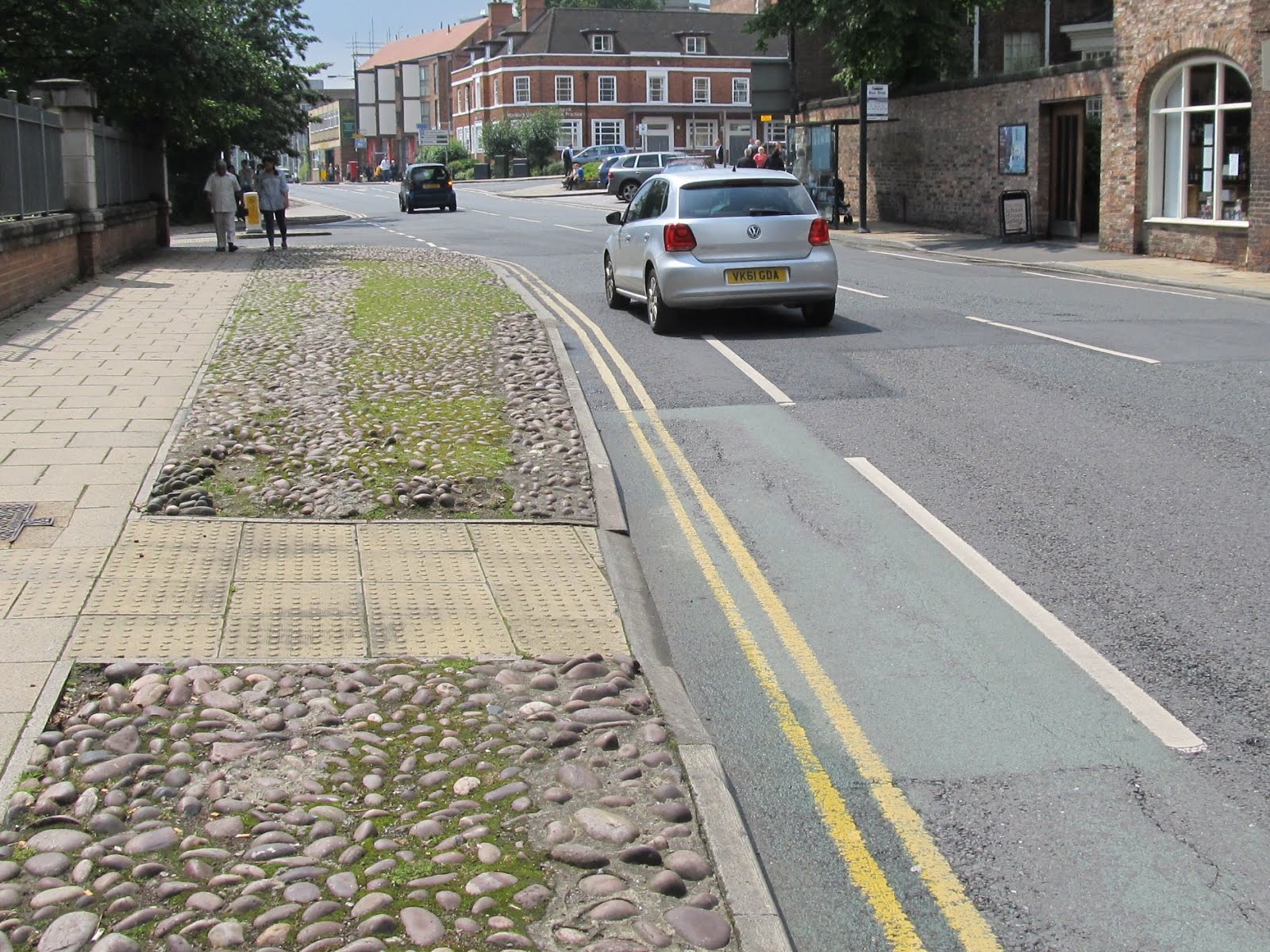
A very simple and economic way of designing for collisions between cyclists and drivers is to ensure that a cycle lane is brought into conflict with overtaking motor vehicles. This example from Peasholme Green in York possesses all the design virtues of classic simplicity. This is a primary route into the city centre. The cobbled verge possesses no historic significance and the cobbles were placed there for aesthetic reasons.


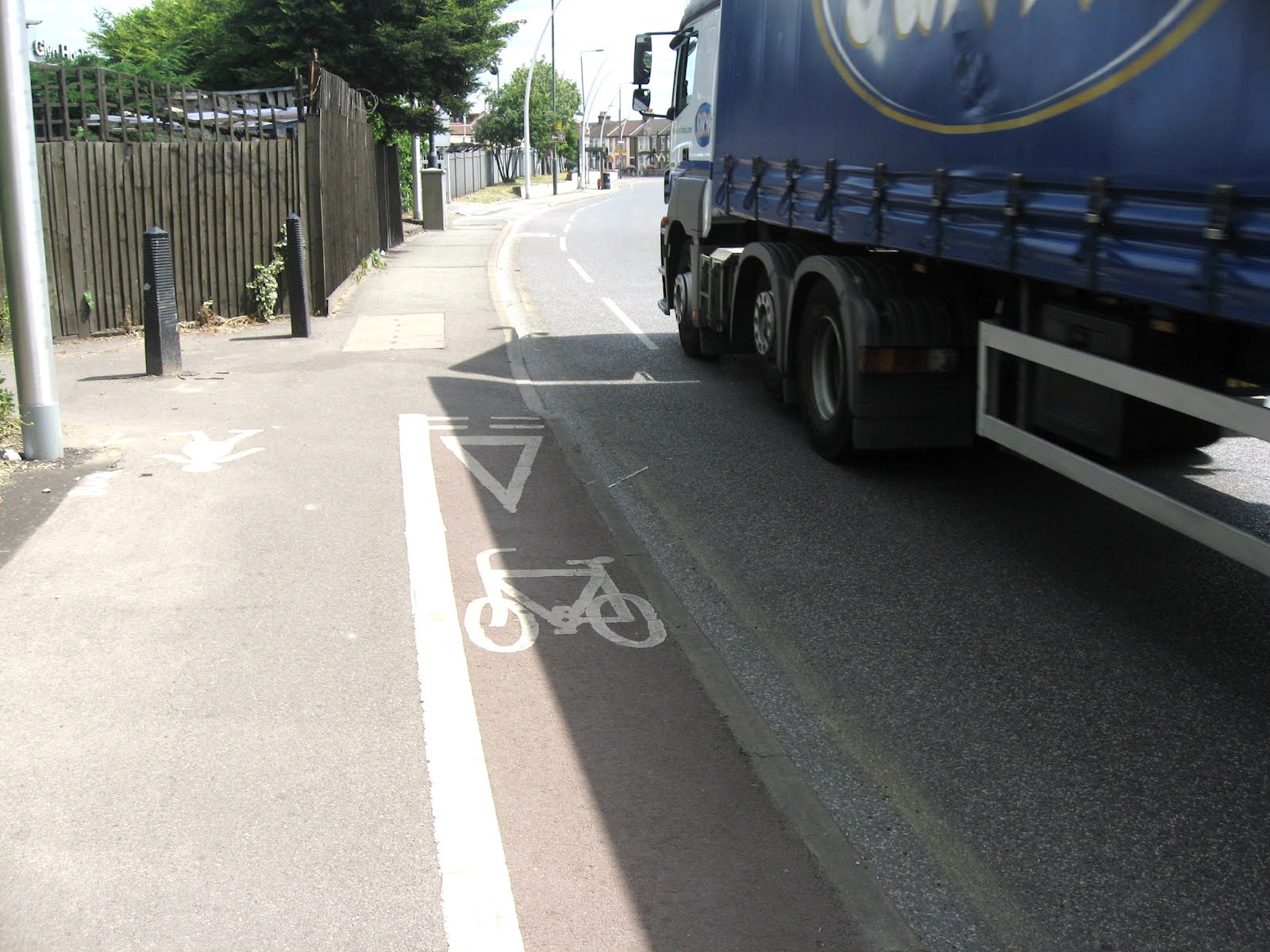
However, simply bringing cyclists and drivers into conflict may not be enough to suppress all local cycling. It may be necessary to add an extra refinement, in which case ‘dooring’ should always be considered as an optional extra. This example on Ruckholt Road in Leyton demonstrates how best to situate a cyclist between overtaking lorries and car parking bays.

Saturday, 29 September 2012

Brick Lane Blues


Back in February At War With The Motorist noticed that

Tower Hamlets council, with £300,000 from TfL, have announced that in the next few weeks they will be replacing the bricks of Brick Lane with a standard issue asphalt carriageway. 

Their rationale was

to “help to distinguish space for pedestrians from traffic”. That is, this is an explicitly anti-shared space move, intended, perhaps, to put pedestrians back in their place.

AWWTM commented

Brick Lane is a far more suitable candidate for shared space than most of the high-profile schemes. It is already a narrow single-lane one-way street with a high pedestrian to vehicle movement ratio — a high place status, in the jargon, and little importance as a transport route. 

Brick Lane is exactly the kind of narrow city street — important place for people but unsuitable for and unimportant as a transport route — where shared surfaces could be beneficial. 

So let’s see how this expensive “improvement” worked out.

 Oh, yes. Marvellous. Very Transport for London. Putting the car-sickness back into the heart of things.

Thursday, 20 September 2012

Leyton Links (3): how to suppress cycling


The plan of this Olympic-funded "improvement" shows the point at which High Road Leyton runs into Grange Park Road.

It promises “Pedestrian crossings improved at this junction, with more planting and seating on the western side, plus potential for temporary art work to enliven the corner building.”

It is not clear what form the pedestrian improvements took, although I suspect it might mean that the footway was built out on the west side to make a shorter crossing.

As for the other projected improvements. Some planting has been carried out by the fence, though the depth is much narrower than shown in the plan. The two benches were not installed. There was no temporary art work because the building on the corner was demolished and replaced by a block of apartments.

Oddest of all, the plan fails to acknowledge that this location is a bus stop.


Six new bike stands have been installed. This is classic tokenism and utterly bizarre. I have never seen a bike locked up here, nor can I imagine who would want to park their bike here. It’s a bleak location which is not close to any shops or other obvious source of interest. It’s also perverse when other sites in the borough are crying out for decent bike stand provision (by Sainsbury’s in Walthamstow High Street, for example, which has just two stands, and a further three nearby on Willow Walk – utterly inadequate provision for a very busy area).


From a cycling point of view the on-road provision is atrocious. A crap cycle lane fizzles out at the bus stop.


However, by far the worst aspect of the design is that the footway build-out creates a lethal pinch point which forces cyclists into conflict with motor vehicles. These were the three vehicles which came along, one after the other, while I stood and took photographs. You can see the problem. Needless to say, this pinch point is completely unnecessary. It simply underlines how no one involved in transport planning in Waltham Forest has a clue about how to design for cycling, or cares about the borough’s dismal cycling rate.


I should add that Grange Park Road forms the first part of a triangular one-way gyratory which is deeply hostile to cycling. This shows the High Road from a point further north, looking towards the junction under discussion. The scope for Dutch-style segregated cycling infrastructure on this "A" road is blatantly obvious. However, no one is asking for it. And the crap council even allows parking in the bus lane between 10 am and 4 pm.


Tuesday, 11 September 2012

A Bridge Too Far


The leader of Waltham Forest Council and the Chief Executive dress up as cyclists to celebrate wasting £1.8million on a new cycle and footbridge over Ruckholt Road to provide a vital gateway for residents and visitors to access the Olympic Park during and after the Games. 


It’s a substandard bridge which is not fit for purpose. (The vision of thousands of pedestrians and cyclists pouring over it to the Olympic Park also turned out to be somewhat exaggerated.) For a start, it’s crazy to funnel cyclists and pedestrians into a narrow space like this.


On the other hand it’s hard to imagine any cyclists wanting to use this bridge, which you can see in the far distance here. At this point westbound cyclists heading from Ruckholt Road to Eastway are invited to leave the carriageway and join a cycle path which after about twenty metres becomes "shared use".


Having crossed the bridge, cyclists are then dumped back into a two lane highway of fast moving motor vehicles with no prior warning to drivers and no physical protection.


A similar design can be found nearby, where the award winning off-road Orient Way cycle path dumps cyclists into the face of fast moving high volume traffic heading east - again, with no physical protection.


To put it at its simplest: this bridge is a complete irrelevance for cyclists, and this kind of “shared use” infrastructure is not the kind of thing which is going to encourage people to take up cycling and keep at it. What is needed on this very busy route is complete segregation of cyclists from both motor vehicles and pedestrians. The space is there, even the money is there. What seems to be lacking is knowledge of what works to get people cycling.


Footnote 

There’s a parallel of sorts here:

It is particularly sad to see penny-pinching and compromises that will reverberate down future decades being built into new, expensive infrastructure. At the quaint town of Shoreham-by-Sea, the route needs to cross the harbour. A bridge built in the early 20th century about 1.5 metres wide currently carries two directions of pedestrians, cyclists (dismounted of course), buggy passengers, wheelchair and mobility scooter users, and pets. On a busy day the result is of course great frustration. 

The good news is that this bridge is going to be replaced with a new one costing £7 million, and work has already started. The bad news is that the new bridge will be only 4 metres wide. To many people I expect a 4-metre wide bridge for non-motorised transport sounds generous. But it is obvious to anyone looking at the situation now on a day like Saturday that is is not. It is a short-sighted penny-pinching compromise. Two directions of cycle travel over a long bridge on their own would need 3.5 metres, and the remaining 0.5 metres is not enough for the rest. We never seem to make bridges for non-motorised modes wide enough in the UK. We used to be a nation of great engineers: why can't we learn about this?

Thursday, 6 September 2012

Exhibition Road revisited (with a footnote on Richard Lewis)


(Above) Exhibition Road: the planner’s fantasy
(Below) The car-centric reality.

The pedestrians in the foreground are waiting to cross the road after their first attempt failed when drivers declined to give way.


(Below) Removing the carriageway markings for this signalled pedestrian crossing on Exhibition Road results in it being obstructed by a luxury car and a black cab when the light is green for pedestrians.


Exhibition Road has been well-blogged about and I don’t really have anything of substance to add to what hasn’t already been said before.

Shared space does precisely nothing to challenge the hegemony of the car and can actually make things worse for cycling.

Specifically, the ludicrous and exaggerated claims made about Exhibition Road have been debunked here and here.

However, one commentator complained Can’t we give it a bit more than a week to declare it a huge failure? 

This blog is happy to oblige.

Many months later shared space on Exhibition Road seems to me to be a huge failure.

Exhibition Road remains a street where cycling and walking are subordinated to the hegemony of the motor vehicle. For cyclists there is no safe, segregated cycle path but simply vehicular cycling among high volumes of traffic. For pedestrians there is nothing more on offer than the old footways and some space between the western footway and lines of parked cars.

Bear in mind that this car-centric farce on a single street cost a staggering total of £29 million.

The paving is attractive but that doesn’t compensate for the comprehensive failure of this street. It doesn’t even have adequate cycle parking. Even though it is at the very heart of three major London museums (the Natural History Museum, the Science Museum and the V & A), and even though tens of thousands of visitors come this way on foot, this is not a civilised space.

The solution is blindingly obvious. The whole of Exhibition Road should be pedestrianised (with cycling permitted). And motor traffic on the A4 should be put in a tunnel.


(Below)  Cyclists crossing the A4 from Exhibition Road don’t strike me as looking particularly relaxed.


(Below) As a cyclist pulls out to avoid pedestrians still crossing after the lights have changed, the bus driver behind applies the brakes.


(Below) A cyclist interacts with a car at a roundabout on Exhibition Road


Plenty of parking for cars on Exhibition Road but very few cycle stands.


A taxi drives on what was previously the footway in order to deliver passengers to a museum entrance.


Pedestrian flow is subordinated to rat-running cars emerging from side streets.


There is one road where the claims made for Exhibition Road come true. But this isn’t Exhibition Road but an adjacent street, Thurloe Street. The reason for pedestrians having the confidence to take over the carriageway is perfectly simple. One end is blocked off to motor vehicles, preventing it becoming a rat run.


Footnote: Richard Lewis and Exhibition Road

Richard Lewis is a “London Cycling Campaign technical expert” as well as “a principal policy planner for the London Borough of Newham” and “a long-time campaigner for sustainable transport, cycling and better cities for people.”

His notion of sustainable transport has been subjected to criticism here and here and here and here.

Mr Lewis illuminatingly articulates his own point of view in the comments here.

Long before all this he attracted just a touch of sarcasm (lawks!) here.

Trawling through the interweb archives I was somehow not at all surprised to come across Richard Lewis enthusing about Exhibition Road:

The application of RDRF should alter peoples' perception that roads are dangerous, thus making them more willing to walk or cycle. Richard gave as an example the proposals for Exhibition Road (to remove all edges, signs etc and to pave it in diagonal squares). 

and


Richard explained the concept of self explaining streets, the design and implementation of which involves the removal of street furniture, lining and excess signage and traffic controls. The idea is to create uncertainty and a sense of risk – so that drivers actually behave safely, and pedestrians and cyclists have the confidence to use the whole street rather than being herded to allocated areas. 

Richard Lewis’s thesis that the kind of treatment seen on Exhibition Road results in “pedestrians and cyclists [having] the confidence to use the whole street rather than being herded to allocated areas” seems to me to be completely without foundation. 

The notion that drivers "behave safely" on Exhibition Road also seems to me to be bizarre. The speed limit is nominally 20 mph but it is plain that some vehicles are going very much faster than that and there are no physical restraints on excess speed.

Exhibition Road is not the way forward but is rather just another way of accommodating the hegemony of the car to the detriment of both walking and cycling.

Thursday, 4 August 2011

A tale of three cyclists


Russell Square. Obviously there wouldn’t be room on a narrow footway like this for a separate cycle track…


I must admit when I took a look recently at the ‘improvements’ to the south side of Russell Square I was very surprised. The old right-turn lanes into the Square have been blocked off and transformed into footway. You can see the line of the old kerb in the photograph above. This is very good news for pedestrians. It is bad news for cyclists, however, because now you have to wait a little further down the road, and make a sharp right turn.

What is absurd about the new design is that it could so easily have accommodated a cycle track. To be viable, however, it would also require lights with a dedicated ‘cyclists only’ green phase. As things stand, Russell Square remains a fundamentally car-centric location, and the so-called ‘improvements’ have actually made cycling worse – less safe, less convenient, more off-putting to all but hardcore cyclists. It didn’t have to be like this. And apart from the grotesque absence of cycling infrastructure on the Dutch model, the Square should have been humanised by blocking it off to through traffic. It would be perfectly easy to close the Square to through traffic by strategically-placed road closures which still permit access to essential traffic while deterring rat-running.

(Below) Let’s swing the camera round and look at the south side of Russell Square, facing west. The so-called ‘improvements’ involve a major narrowing of the carriageway, with parking bays for buses and coaches on one side and parking bays for cars and other vehicles on the other. Cyclists are squashed closer to motor vehicles. This is a truly incredible scene when the possibility of a wide, safe, segregated cycle track is blatantly obvious. It’s another testimony both to the lack of vision of London transport planning and its parochial ignorance of cycling infrastructure on the Dutch model which supplies a proven model of spectacular success.


(Below) Look carefully and you will see two cyclists in these photographs. Both want to turn right into Russell Square (south side). One is an elderly male cyclist, who obeys the rules. The other is a much younger helmet-clad male. The younger cyclist swings out into the fast lane of north-bound traffic coming from Southampton Row, which is empty of traffic because it is held at a red light on the other side of the junction. He jumps the light and cruises into Russell Square. He is not at risk from drivers, because all lanes are held at red. However, this involves passing over the pedestrian crossing at green. In this instance there is no conflict since the cyclist passes behind the one pedestrian who is crossing.


(Below) The elderly cyclist, now stationary, positions himself correctly to turn right. He gets some protection from having a right-turning motorcyclist behind him, otherwise he would be even more isolated and vulnerable, trapped between two lanes of large vehicles. The driver of the massive oncoming Dutch articulated lorry has to move over to his left to avoid the rear end of the lorry hitting the cyclist, then straightens up. The Dutch lorry is a left-hand drive vehicle, which means the driver is on the other side to the cyclist.


(Below) With a gap in the traffic, the elderly cyclist is at last able to turn into Russell Square. Take a look at what is happening in the background: a blue car and a cyclist travelling north on Southampton Row, towards the camera, both approach the junction.


(Below) Note that in the background the blue car is now travelling parallel with the cyclist, both moving at the same speed.


(Below) A near miss. The driver of the car turns left into the path of the cyclist who is going straight ahead. My photo catches the moment the cyclist swerves away and glances in surprise at the driver, who brakes.


Left-turning drivers at this location (above) may be misled into thinking that a cyclist is also turning left because the road lay out here involves the road widening by the Square, with the north lane turning into two lanes. Cyclists move slightly to the left to go into the slow lane.

(Below) The cyclist (doubtless a little shaken by the experience) continues on his way, while the car turns into Russell Square.


The moral of this sequence of events? For a cyclist, jumping a red light can sometimes be a lot safer (and quicker and more convenient). And it is pointless condemning such behaviour when the road network is built for the convenience of drivers, without safe and convenient infrastructure for cycling, and where rules designed to protect cyclists are not enforced. Darwin would have understood contemporary cycling behaviour in Greater London.

Tuesday, 2 August 2011

a new Olympic cycle track: this is as good as it gets

This is the brand new Olympic cycle track (or Greenway) which runs along the north side of Whipps Cross Road (A114), all the way from the Green Man Interchange to the roundabout at Whipps Cross.


What not to like?

Plenty. It’s not quite finished yet and not officially open but its design deficiencies are glaringly obvious. This, for example. (Below) A sensitively located sign for motorists.


As far as I can tell it’s intended to be a two-way cycle track. Its core failing is that it is shared use. So it's not really a cycle track at all. Even though there was plenty of space to put in a separate physically segregated footway running parallel to the cycle track this has not been done. Along its entire length, two-way cyclists will be sharing with two-way pedestrians.

(Below) Conflict with pedestrians. A bus shelter, a bus stop and a distant zebra crossing - nicely spaced to give those lazy bus-users plenty of exercise.


(Below) More conflict, with both pedestrians and drivers. People queue on the path for service at this wooden hut (which is very popular and sells refreshments 24 hours a day), just beyond which is the entrance to a car park, where cyclists and pedestrians are naturally expected to give way to vehicles. A properly designed cycle track would have required a complete re-design which involved moving the car park and the hut further back. And there is nothing at all to stop drivers parking on the Olympic Greenway. (To be fair to the council, they did want a better design than this by the hut but they experienced systematic opposition from the anti-cycling City of London, which owns the land.)


(Below) There’s a second car park, where cyclists and pedestrians are again naturally expected to defer to drivers. Cyclists will again be slowed down by the presence of pedestrians across the path. And even before the path is officially open a trader has placed advertising on it. Waltham Forest council has a long history of ignoring unlawful obstruction of the footway by traders.


It would be interesting to know what design model was adopted for this infrastructure, which has failure built into it. I don’t remember this scheme ever being put up for consultation by the council, and I don’t know if the local branch of the LCC was ever consulted, and if it was what comments or criticisms were made.

One day this scheme will have to be re-done but obviously that will only happen when Waltham Forest Council addresses the reasons for the failure of mass cycling in the borough and begins seriously to engage with car dependency and car prioritisation. The current leader of the council, Cllr Chris Robbins, is obsessed with encouraging car use and car parking, so the prospects for mass cycling in Waltham Forest remain at present very, very bleak.

However, the main reason why this new Olympic ‘Greenway’ will fail to result in masses of people cycling to and from the Olympic site lies outside the basic design flaws of this unsatisfactory cycling infrastructure. It’s that to access the cycle route you first have to cycle in conditions like this (below). If you leave the Greenway at Whipps Cross roundabout, using the zebra crossing by the hospital entrance to get across the A114, this is what you have to cycle in if you are heading west down Lea Bridge Road or north along Wood Street. Two to three lanes of motor vehicles jostling for position, with vehicles sometimes travelling at high speed.