Normally when you clock up twelve points you lose your driving licence. However if you can persuade the court that taking away your right to drive would involve you in “exceptional hardship” then you may be allowed to continue driving. After a recent BBC documentary exposed the case of one driver who continued to clock up points way beyond the 12 point maximum and was still allowed to go on driving, I used the FOI to ask the Driver and Vehicle Licensing Agency how many drivers were currently on the roads in the UK, legally driving with 12 points or more on their licence. This is the reply I received. What it reveals is that a tiny, privileged minority are allowed to repeatedly offend, with courts indulging the offender’s desire to maintain the right to drive a car while repeatedly breaking road traffic law.
The following table shows the number of drivers in Great Britain who currently have more than 12 penalty points on their driving licence and have not been disqualified from driving by the Courts. These figures reflect the information held as at 16 May 2011.
Current Pts Total no. of drivers
12 7,014
13 804
14 881
15 1,093
16 296
17 147
18 245
19 38
20 49
21 38
22 13
23 16
24 24
25 3
27 3
28 1
30 4
33 1
36 1
Grand Total 10,671
Whilst DVLA maintains a record of all GB fixed penalties and Court ordered endorsements, the Agency has no responsibility or influence on Court imposed sentences. Magistrates' Courts use Sentencing Guidelines published by The Magistrates' Association that provide a framework setting out how to establish the seriousness of each case and the most appropriate way of dealing with it. This helps ensure that any penalty reflects the seriousness of the offence and the personal circumstances of the offender.
In a small percentage of cases where the driver has accumulated 12 or more penalty points, the Agency understands that a Court can exercise its discretion and not disqualify the driver. In the majority of these cases, Magistrates may have decided to allow drivers to retain their entitlement to drive where it is considered that disqualification would cause exceptional hardship.
DVLA’s drivers database changes constantly as the Agency receives driving licence applications and other information that updates the records of individual drivers. Therefore, it is possible only to provide a snapshot of the state of the record at the time of any request. It should be noted that there can be a delay between the notification of penalty points and of disqualification. These can update the driver record separately.
Monday, 6 June 2011
Sunday, 5 June 2011
Walthamstow pedestrian killed in hit and run crash


On Wednesday evening the emergency services were called to
the junction of Markhouse Road and Markhouse Avenue in Walthamstow following reports of a collision.
A female pedestrian was taken to an east London hospital with serious injuries.
The car involved in the collision, which is believed to be a dark coloured Mercedes C-class, failed to stop at the scene.
The woman, who was Vietnamese, died the next day but has not yet been formally identified.
Police want to trace the driver of the car, thought to be a C180 or C220 model, which was driven away from the scene towards Blackhorse Road.
This seems to be the first hit and run killing in the borough since a cyclist was run down and killed on Forest Road in 2007 (the driver was never traced).
The victim, whose identity is now known but which has not as yet been released by the police, was apparently in her twenties.
The crircumstances of the collision currently remain obscure. BBC News says she was run down on Markhouse Avenue, whereas the local paper says Markhouse Road. The local paper is more likely to be right, and indicates that the collision occurred somewhere between the traffic island by the Presbyterian Church and the junction with Markhouse Avenue. Four days after this fatal collision the Metropolitan Police have yet to put up a sign asking for information from any witnesses.
On the very limited information available at present it seems likely that the victim was crossing Markhouse Road when she was hit by the Mercedes, which was being driven north towards Blackhorse Road.
Markhouse Road (aka the A1006) is a lethal and barbaric road. It seems to have a massive crash record (I’ll use FOI to find out the details). It’s featured on this blog on a number of occasions. It has two schools on it (you can see the primary school playground behind the bus stop in the first photo above), churches and a leisure centre, as well as terraces of residential housing, yet the through-driver reigns supreme.
A major problem is speed. It is nominally a 30 mph road but many drivers are plainly exceeding that limit. The crap council’s idea of traffic calming is putting in traffic island/pinch points, which are no use to pedestrians (try getting stranded on one with two small children, or if you are old and walk with a stick), and which force even normal size cars into the crap advisory cycle lane.
The solution? It should be a 20 mph road, backed up by speed cameras. That’s the only way to do it. Unfortunately the idea of reducing speeds below 30 mph on an ‘A’ road is anathema to Britain’s car-centric transport culture.
At the very least the council should be ripping out those lethal pinch points and replacing them with zebra crossings. The council has a lot of latitude as this is not a road under the control of TfL.
Markhouse Road is the kind of road which deters all cyclists but those who are confident enough to cycle in such conditions. Me, I would always prefer to cycle on crap Hoe Street, where in daytime the congestion ensures much lower vehicle speeds, than on Markhouse Road, where vehicles travel much faster and come much closer.
(Below) The junction where the crash occurred.
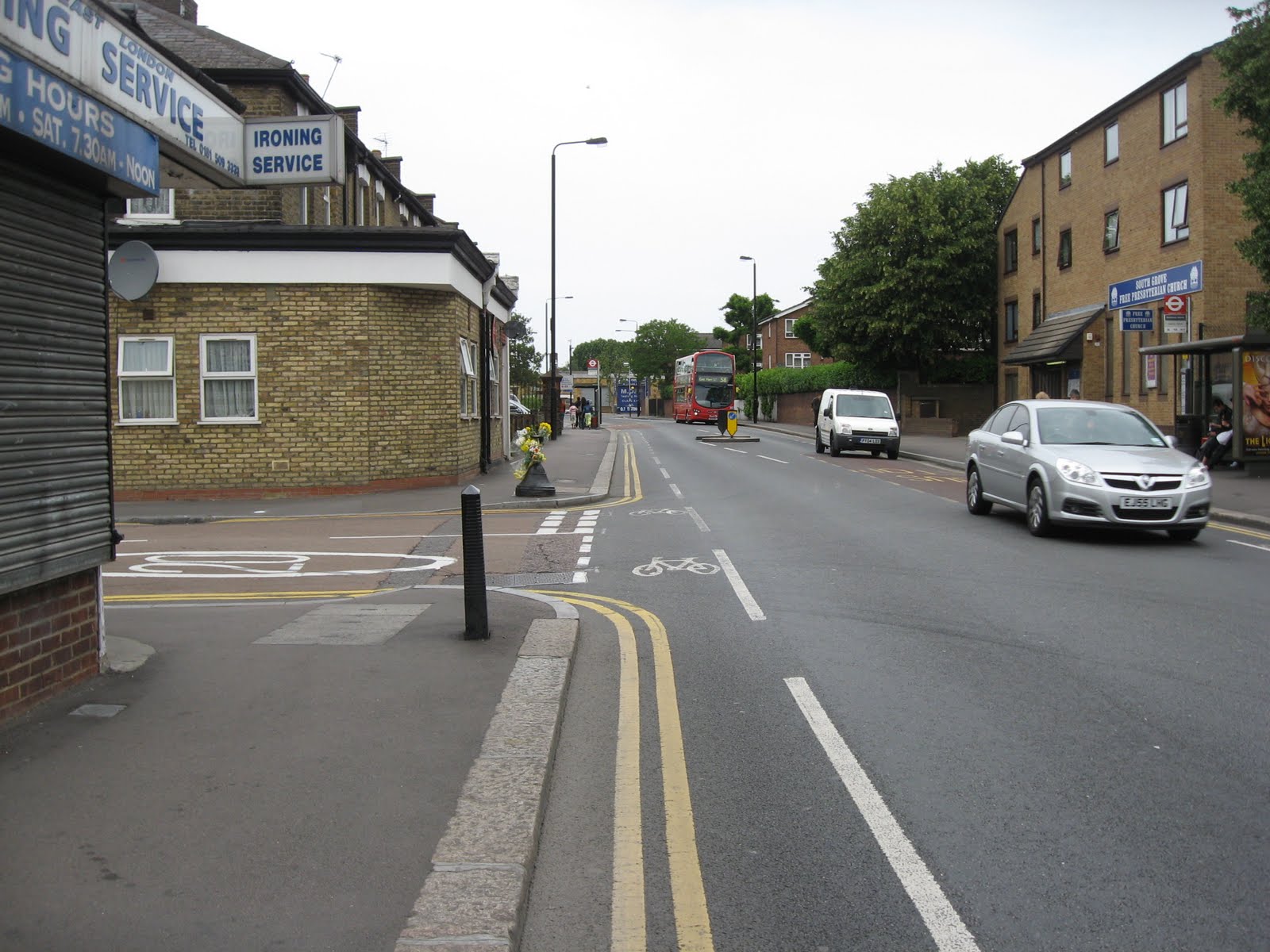
(Below) The crash site. Which is also an example of how to design road infrastructure that forces drivers into the cycle lane.

(Below) While I was taking photographs a cyclist came by - on the pavement. If you don’t provide safe, convenient infrastructure for cyclists, some people will decide to find their own.


Update
TWO arrests were made yesterday following a woman’s death after a hit and run crash.
A woman in her 20s was arrested on suspicion of causing death by dangerous driving and a man in his 20s was arrested on suspicion of perverting the course of justice after the collision in Walthamstow.
A dark blue Mercedes C200 Kompressor, believed to be the vehicle involved in the crash, was also traced after the fatal incident occurred at 10pm on June 1, at the junction of Markhouse Avenue and Markhouse Road.

Barry Mason has died
This is a big, big loss to London cycle campaigning.
As coordinator of Southwark Cyclists he led dozens of free open-access rides which started from the Southwark Needle at the southern end of London Bridge.
He also coordinated popular large-scale rides around the deserted streets of London on Christmas Day and overnight on the shortest night of the year.
His organisational skills were also applied to the annual Dunwich Dynamo night-time ride between East London and the Suffolk Coast. Each year Barry would arrange a fleet of coaches and vans to bring riders and their bikes back to London in the morning.
He also helped to forge strong links between Southwark Cyclists and Southwark Living Streets, the pedestrian-focused campaign group, so that the two organisations presented a common front on many issues affecting walkers and cyclists in the borough.
More here.
As coordinator of Southwark Cyclists he led dozens of free open-access rides which started from the Southwark Needle at the southern end of London Bridge.
He also coordinated popular large-scale rides around the deserted streets of London on Christmas Day and overnight on the shortest night of the year.
His organisational skills were also applied to the annual Dunwich Dynamo night-time ride between East London and the Suffolk Coast. Each year Barry would arrange a fleet of coaches and vans to bring riders and their bikes back to London in the morning.
He also helped to forge strong links between Southwark Cyclists and Southwark Living Streets, the pedestrian-focused campaign group, so that the two organisations presented a common front on many issues affecting walkers and cyclists in the borough.
More here.
Saturday, 4 June 2011


Thursday, 2 June 2011
The London Cycling Campaign changes direction

(Above) Conditions for cycling on Charing Cross Road in central London
(Below) Conditions for cycling outside Leyton tube station, High Road Leyton (close to the Olympic Village)

Once upon a time there was a cycling blogger who wrote
I cancelled my membership of the London Cycling Campaign. I should put a link to their page, but I’m not going to, because I think they suck.
My sentiments exactly. Although it wasn’t me who wrote that, it was legendary Buffalo Bill, who went on to remark (more wild applause)
Their big idea, the London Cycling Network, a network of X 000 miles of cycle lanes and paths, is a joke, and LCN+, supposedly the new improved version of LCN, is an even bigger joke
Bill had a follow-up rant here.
My own lusty application of a hatchet can be enjoyed here. Sadly many of those links are now irretrievably broken, because the LCC has revamped its website.
My heart sank when I read the précis of the speech given to last year’s Cyclenation conference in Edinburgh by Ashok Sinha, the LCC's new Chief Executive, who
Noted the greater diversity of cyclists now on the road and a change in attitude by the media.
(I hadn’t noticed either. And cyclists still seem to be among the folk devils of modern Britain.)
Outer boroughs have much potential for growth but lack of strategic direction now, with demise of Cycling England.
The idea that any of the Outer London boroughs have ever had the slightest degree of ‘strategic direction’ regarding the expansion of cycling is amusing. The existence of Cycling England never made the slightest difference whatever to the fortunes of cycling in such nirvanas as the London Borough of Waltham Forest.
Cycling has come onto the political agenda, and is backed in high places.
Under the ConDem regime? Do I really need to comment?
All this sounded like the traditional LCC message: If you're happy and you know it, clap your hands.
But lo! Something is happening at the LCC. The tectonic plates are trembling. A wind of changing is blowing through the organisation. The conventionally inert LCC stunned a lot of us by organising a protest on Blackfriars Bridge! It even took it to the doors of the hated car-mongering traffic-flow-smoothers at Transport for London! And organisationally the LCC is rebranding itself as London Cyclists.
The organisation's explanation for these changes include:
as cycling has increased in popularity, and as other bodies are increasing their own outreach to cyclists, our membership (and activism) must grow in line. At the moment it isn't, and hasn't for some time. We need a change in approach.
we are revamping our approach to income generation to enable this increased campaigning work and make us less dependent on external funding. We narrowly avoided an extremely damaging drop in income this year and need to buttress and increase our funding base. (In passing, we envisage that a name change will be helpful in this area too.)
Finally we are overhauling our policy positions to give them greater coherency and clarity, and it will better articulate them to decision-makers and the public.
Whatever the reasons for them, I think the LCC's changes of direction are very welcome. Are they enough to make sullen and peevish ingrates like moi return to the fold?
What do you thnik of the new website? asks the new website. Well, I thnik it’s much, much better than the old one, although sum attenshun to the speling mite be good. Lovely photos though and very stylish… All the crap advertising seems to have gone, including such gems as the one urging LCC members to join the AA. The new website is currently a lot thinner in its content (the grand 5 year plan for cycling has vanished, as has the list of corporate sponsors - now people like me won't be able to poke fun any more at LCC sponsors whose websites mention car parking but not cycle parking).
As for policy. The old website was a mess and you had to engage in a major archaelogical dig to find out what the LCC actually stood for. The new website clearly and prominently articulates a set of objectives and positions. (London-wide the LC remains an institutionally incoherent organisation because its individual branches articulate widely different philosophies of cycling and campaign objectives - for example, in Hackney they loathe cycle lanes and oppose them, in adjacent Waltham Forest they support and praise them.)
It’s excellent that the LCC (or should I call it LC) has embraced Road Danger Reduction rather than the collaborationist, blood-drenched entity that is the ‘road safety’ industry.
Crikey! The LC has even starting talking about subjective safety – and we all know where that came from.
It’s even embracing segregation:
We support the implementation of cycle tracks when speeds and volumes of motor traffic are high, on streets such as Old Kent Road or the Embankment.
That seems a bit perfunctory to me. It doesn’t say ‘we will actively campaign for’. It’s also ambiguous: it seems to suggest that the LCC only embraces segregation where both speeds and volumes are high. Or to put it another way: does it embrace segregation on Charing Cross Road (say) where traffic volumes are high but speeds often low? Me, I want to see the LCC coming out with a list of London's top priority streets for segregation.
The policy statement continues:
Installing segregated tracks on every street in London is impractical, and we'll continue to call for other measures such as removing through traffic and speed reductions on local streets.
But this is a caricature of what those of us who want Dutch cycling infrastructure are asking for. No one has ever suggested a segregated cycle path on every single street in Greater London. Eliding that with generalisations about street closures and speed reductions isn’t helpful because these last two goals don’t in themselves bring about mass cycling.
But here’s the crunch, and this is where my enthusiasm for the rebranded LCC starts to falter.
There's no magic wand that will instantly boost cycling from its current meagre figure of 2% of all journeys in Greater London to levels enjoyed by successful neighbours such as Denmark and The Netherlands.
What's needed is a whole range of measures to reduce road danger, improve infrastructure, and increase the attractiveness of cycling to the average person in the street.
Talking about magic wands sidesteps the simple reality that even in those two European examples one is significantly more successful than the other. The LC's 'magic wand' stuff strikes me as a fudge because it evades the core principle of the Dutch cycling renaissance, which is separation from traffic. And the infrastructure which first began to turn the Netherlands around was the creation of bike grids on major routes. Unless you are prepared to bite the bullet and start making that the central campaigning goal then everything else is a waste of effort, because there’s just no evidence that all these secondary campaign goals such as 20 mph zones are in themselves adequate to overcome the current mass resistance to cycling.
The London Borough of Waltham Forest already has all the stuff which many campaigners elsewhere still dream of - lots of 20 mph zones, extensive traffic calming, rigorous parking enforcement, 40 miles of cycle lanes and quiet routes, road closures etc etc, and NONE OF THIS HAS WORKED. Cycling's modal share in the borough currently stands at less than one per cent. That's because none of that cycling infrastructure has addressed on-street car parking, which is at saturation levels and getting worse, or the convenience and perceived cheapness of travel by car for very short journeys. All the most direct routes for cycling in Waltham Forest are on 'A' roads with large volumes of traffic, which deters all those apart from hardcore cyclists prepared to cycle on 1.5 metre cycle lanes alongside lorries, sometimes squeezed between long bays of parked cars and overtaking traffic. Cycling is very visibly unpleasant, marginalised and risky on all the major routes. You will never build a mass cycling culture in such conditions.
The idea that you can somehow generate mass cycling through lots of small initiatives is a very popular one, particularly among the committed vehicular cyclists who dominate cycle campaign groups. There’s a good term for that strategy: ‘pepper-potting’. Indeed, the whole history of ‘encouraging cycling’ in Britain over the past 20 years is about pepper-potting, whether by local authorities or cycling campaigners. But it hasn’t resulted in mass cycling, no matter how desperately the figures are spun, or how often individuals insist that they can see more cycling on their local streets. Objective cycle measurements always tell a very different story.
Check out 3.6.3 in this document (yes, I know the source is deeply ironic)
It is also acknowledged that ‘pepper-potting’ of walking and cycle improvements across a wide area is of limited value and delivers limited increases in walking and cycling activity.The entire walking and cycling experience throughout an entire route needs to be improved in order to achieve the ambitious increases in levels of trips by these modes that are required in order that the quantum of proposed development can be delivered.
Or to put it another way:
Both the need to feel safe whilst cycling, and the need for it to be convenient are provided where there are Dutch-style segregated facilities (and the extra options it opens up for reducing the speed, volume and permeability available to motorised traffic).
The LC's position on segregation needs to be rather more explicit than it is, and more coherently worked out, before I shall be renewing my lapsed membership. I'll be watching to see if it is. In the interim I think the new changes at the LCC are very welcome and long overdue.
(Below) Cycling infrastructure on direct convenient routes: High Road Leyton and Forest Road, Walthamstow. No cyclists were available for these photographs.


Wednesday, 1 June 2011
Transport for London won’t answer questions about cyclist death junction


Camden Road, where a cyclist was crushed to death by a left-turning lorry. A four-lane highway for motor vehicles. No cycling reservoir (ASL). Not even a poxy cycle lane. And no crossing lights for pedestrians at three of the four arms of this junction.
After the death of cyclist Paula Jurek at this junction in Camden (there’s more here ) I made an FOI request to Transport for London asking:
What requests have been made to TfL in the past by Camden Council and others for improvements for cyclists and pedestrians to the junction of Camden Road (A503) and St Pancras Way (A5202)?
What has the response of TfL been to each of these requests?
Transport for London claims it is unable to answer these simple questions. This is the reply I’ve now received:
Your request has been considered under the requirements of the Freedom of Information (FOI) Act. Unfortunately, to provide the information you have requested would exceed the 'appropriate limit' of £450 set by the Freedom of Information (Appropriate Limit and Fees) Regulations 2004.
Under section 12 of the FOI Act, we are not obliged to comply with a request if we estimate that the cost of determining whether we hold the information, locating and retrieving it and extracting it from other information would exceed the appropriate limit. This is calculated at £25 per hour for every hour spent on the activities described.
We have estimated that it would cost approximately £625 to provide a response to your current request. Improvements along Camden Road have been investigated over the past seven years during which time many departments have reorganised and changed. We would need to retrieve information from accounts of employees that have left the organisation and assess and compile which information is relevant. Due to the volume of information held, it would take approximately 25 hours to retrieve, assess and compile the information you have requested. We may be able to answer your request if this could be narrowed down, for example to cover a shorter time frame or to include a specific department within TfL.
This response strikes me as evasive. I wasn’t asking about “Improvements along Camden Road” but about a very specific junction. A seven year time frame might be considered long if I’d been asking about every request for improvements made along the entire length of Camden Road, but I wasn’t. It’s also not helpful to be told I should have addressed my questions to specific departments within TfL, when I know nothing about the internal structure of TfL and TfL avoids enlightening me as to what the relevant department(s) might be. Computers also makes data retrieval very, very easy, since all you need to do is tap in key words to extract the information you require. I am not convinced it would require more than 25 hours at a computer to answer my questions.
It seems to me that TfL is being deliberately obstructive. After Paula’s death the claim was made that Camden Council had repeatedly requested improvements to this junction – improvements which TfL had repeatedly turned down. I find that entirely plausible, since this lethal junction is yet another embodiment of TfL’s car-centric obsession with ‘smoothing traffic flow’ at the expense of cycling and walking. But in the aftermath of a fatal collision TfL doesn’t want to own up to what requests it has turned down and what the rationale was (although I think I can guess: for example, putting in lights for pedestrians at the other three arms of this junction, including the two which cross Camden Road, would impede motor vehicle flow and ‘cause congestion’).
TfL is the enemy. London is now one of the most backward major cities in Europe, with polluted air and car-choked streets which are hostile to walking and cycling. The risible modal share that cycling has in Greater London is a direct consequence of the ways in which Transport for London continues even to this day busily designing its vision of London as a haven for maximum through-put of motor vehicles.
If you have any FOI requests to make of TfL just email them to this address:
enquire@tfl.gov.uk
Two attacks on cyclists
The curious common factor in these two assaults is presumably just a coincidence…
Police investigating the shooting of a cyclist with a BB or pellet gun in Hampshire have released a CCTV image of a man they want to trace.
Two men were cycling down Bramshill Road in Eversley when the passenger of a silver Ford Focus leaned out of the window and fired at them, police said.
and
A cyclist attempting to pedal the length of Ireland for charity says he was left badly shaken after someone in a passing car deliberately pushed him off his bike on the outskirts of Derry.
English cyclist Ian Mayhew and his girlfriend were cycling along the Culmore Road late on Saturday afternoon when he says a passenger in a silver Ford Focus leaned out the window and struck him.
“It was most certainly deliberate,” Ian told the ‘Journal’ yesterday. “The driver of the vehicle pulled his car alongside me as I pedalled and closed the gap between me, the kerb at the edge of the road. The rear seat passenger leaned out of the car and deliberately hit me causing me to fall off, hitting the kerb and pavement.”
Meanwhile in Oldham County:
On May 28, Schmidt was riding through Oldham County with three other cyclists. Everything was fine until they got into a Pewee Valley neighborhood.
"First I thought it was just a pebble thrown by a car tire that had hit me and then I heard a popping again," said Schmidt. "That's when I realized, that sounded like a BB gun."
The riders tried avoid the main roads to stay out of the way of traffic, but that didn't seem to help.
"All the sudden it made a loud pop and immediately I felt some sharp pain in the left side of my chest," said Schmidt.
Schmidt thinks the shots came from a white Ford Ranger pickup truck.
Police investigating the shooting of a cyclist with a BB or pellet gun in Hampshire have released a CCTV image of a man they want to trace.
Two men were cycling down Bramshill Road in Eversley when the passenger of a silver Ford Focus leaned out of the window and fired at them, police said.
and
A cyclist attempting to pedal the length of Ireland for charity says he was left badly shaken after someone in a passing car deliberately pushed him off his bike on the outskirts of Derry.
English cyclist Ian Mayhew and his girlfriend were cycling along the Culmore Road late on Saturday afternoon when he says a passenger in a silver Ford Focus leaned out the window and struck him.
“It was most certainly deliberate,” Ian told the ‘Journal’ yesterday. “The driver of the vehicle pulled his car alongside me as I pedalled and closed the gap between me, the kerb at the edge of the road. The rear seat passenger leaned out of the car and deliberately hit me causing me to fall off, hitting the kerb and pavement.”
Meanwhile in Oldham County:
On May 28, Schmidt was riding through Oldham County with three other cyclists. Everything was fine until they got into a Pewee Valley neighborhood.
"First I thought it was just a pebble thrown by a car tire that had hit me and then I heard a popping again," said Schmidt. "That's when I realized, that sounded like a BB gun."
The riders tried avoid the main roads to stay out of the way of traffic, but that didn't seem to help.
"All the sudden it made a loud pop and immediately I felt some sharp pain in the left side of my chest," said Schmidt.
Schmidt thinks the shots came from a white Ford Ranger pickup truck.
Subscribe to:
Posts (Atom)