Wednesday, 15 August 2012

Waltham Forest Walking and Cycling Olympic Souvenir


What was it like in legendary Waltham Forest during those days when Olympic fever swept the borough?

This special souvenir shows some of the unforgettable local sights in a time which has already passed into myth.

Who can forget “the spirit of Waltham Forest” embodied by this local woman who wore the council logo all the way from Chingford to Walthamstow on a very hot day?

Well done, ma’am!


And hats off to these gents, who once again remind us that cyclists are, well, different to the rest of us!

Bless.

Tuesday, 14 August 2012

Brilliant road safety suggestions # 317

As all enlightened cycling commentators know, the absolutely key role that cyclists can play in encouraging safer cycling and winning respect is policing the behaviour of other cyclists.

We also need more legislation, because after all, all British road users scrupulously obey the law.

So hats off to this marvellous suggestion which, if only the government will take it on board, is guaranteed to make cycling even safer than it already is.

It goes without saying that we need a compulsory helmet law to stop the spread of brain damage in the cycling community. (Sadly, there are many cycle discussion threads where it is very, very obvious that the contributors are a bit soft in the head and have not been wearing helmets!)

But let's not stop with a cycling helmet law. Let's go further.

Mr Cawthorn said: “I want the Government to go even further and make it law to wear bright green, yellow or red.

 “Cyclists have to be better protected - too many wear the wrong colour in order to hide mud splashes from roads, but the result is that they become camouflaged.

 “I believe changing the law would save lives.” 

This cyclist (below) ticks all the right boxes and sets an example to everyone. 

Wearing a helmet? YES

Wearing bright green, yellow or red? YES

Making every effort to appear conspicuous to others? YES

Unafraid of mud splashes?  YES


Monday, 13 August 2012

Free Olympic Cycling Souvenir


As a special service to readers we are happy to supply this special cut-out-and-keep souvenir of “cycling in London during the 2012 Olympics”.

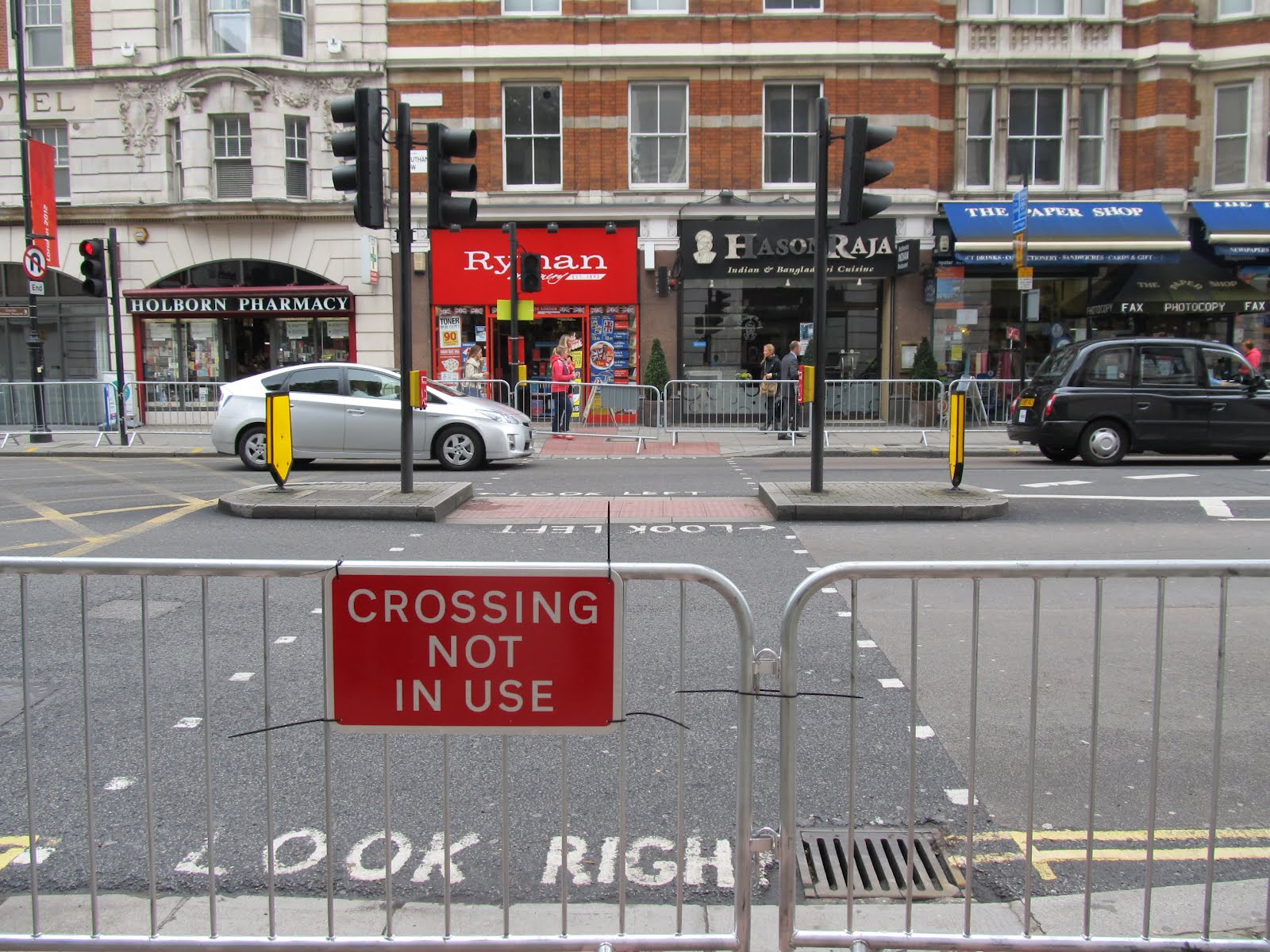
This captures the true atmosphere of the Olympics as it shows what it was like during those golden days when motor vehicle numbers were much reduced and cyclists could cross a major London junction with little for company but a few speeding Games BMWs and London’s iconic white vans.

Sunday, 12 August 2012

The Olympic cycling legacy: it's crap


 (Above) Exciting new infrastructure in the Lea Valley close to the Olympic Park.


 In a nutshell, this is what the Olympics amounted to as far as ordinary cycling is concerned.


 1. The pre-Olympics cycling pledges were broken and the Greenways were never built


(Above) The map shows three proposed Olympic Greenways in the London Borough of Waltham Forest. One already existed in the form of the Lea Valley towpath, which was of course subsequently closed to cyclists and pedestrians at the point where it reached the Olympic Park. The other two, which also incorporated some existing routes, were not built.

(Below) The start of one section of a proposed Olympic Greenway which was never constructed, linking the Green Man roundabout with Snaresbrook Road.


2. The opening night of the Olympics saw the greatest mass arrest of cyclists in British history by a police force which is institutionally anti-cyclist and which has long incubated petrolhead police


Copyright The Press Association


3. With symbolism at its most bleak and brutal a young London commuter cyclist was crushed to death beside the Olympic Park on the sixth day of the Olympics, killed by an official Games vehicle transporting corporate journalists 

This appears to have been a classic instance of a left-turning heavy vehicle colliding with a cyclist who was going straight ahead. The fatality occurred at a site which the London Cycling Campaign over an eight year period had been warning was dangerous for cyclists.

What’s more
 
I have established that “advance stop lines” – the cyclists’ only boxes at traffic lights – were removed from the junction at the intersection of Eastway, Ruckholt Road and the A12 west-bound slip road to give priority to Olympics VIP buses and cars 10 days before the fatal crash.


4. Some sports cyclists won medals, including individuals who have no ethical objections to being sponsored by BP or BMW. And another sports cyclist famously shared his thoughts on cycling safety

(One cycling blogger asked their local council for a breakdown of expenditure on infrastructure for everyday cycling and expenditure on sports cycling; the answer is interesting.)


5. The Mayor of London announced RideLondon: 

Capitalising on the popularity of Britain's two-wheel Olympic triumphs, an annual festival of cycling is to be held in London – including a mass road race to rival the marathon. 

Hugh Brasher, race director for the London marathon and part of the team organising RideLondon, said he believed it would become as big a fixture as the running equivalent, and could continue to inspire cycling after the Olympics. He said he hoped it would "encourage people to get fit, cycle and start commuting into London by bike".

Well it might do. But we know that once you have “encouraged” people to try cycling a phenomenon called “churn” occurs. The majority do not enjoy the experience and give up.

 although many people have taken up cycling in the past decade, a similar number have stopped cycling. 

Sometimes even hardened and experienced vehicular cyclists give up:

Sad to say I have all but given up commuting into London now. It can hardly be described as a pleasant experience and there is no meaningful support from the police. 

But not everyone feels like this.

Trott said she felt safe cycling in London, but added that more cycle lanes should be created. 

Yeah, right. This brilliant cycle lane in Leyton, which runs close to the eastern perimeter of the Olympic Park, is just the thing to get the masses cycling, no?


And all you cheery optimists who cling to the fervent hope that Boris will one day implement his ‘Go Dutch’ commitment, do please pay close attention to this remark:

Johnson said that substantial sums were being spent to make the streets safer for cyclists but said he did not want to "bully" motorists by changing roads, and that there had to be compromises made. 

I was going to say more about RideLondon but the Vole has already said it


(Below) Recommended cycling route to the Olympics, along National Cycle Network route 1, at a point where you can see the Olympic Park. Photographed two days ago.


Saturday, 11 August 2012

Olympic sprint and hurdles events for everyone


As the Olympics draw to a close please remember that Olympic sprint and hurdles events are occurring all over London and participation remains open to all. If you fancy your skills at jumping, then just go for a stroll and try out one of these.


Once you have mastered the art of jumping over an obstacle, the next thing is to attempt sprinting. Central London contains numerous combined hurdling and sprint tracks which are free for the public to use.

Have fun finding out if you can get to the other side of the road without being run down by an Olympic BMW in the Games Lane.


For added fun, bring along a suitcase. Here we see two visitors to London who are attempting the gruelling Parliament Square “crossing the road” track (CAUTION: suitable only for athletes in the peak of condition). They have successfully made it to a traffic island, but already their chances of a gold are fading rapidly as, hopelessly confused, they look in completely the wrong direction!


Here they have corrected their error. But what they haven’t spotted is that there is a surprise hurdle directly ahead of them just as they think they’ve finally managed to cross the road!


These foreign visitors (below) make the same discovery. Watch as they run shrieking from multiple lanes of approaching motor vehicles, in the final round of the gruelling and highly dangerous “safety in numbers” event.


From the Bow Roundabout comes this particularly impressive piece of film of a gold medal winner:

note that not only are there no pedestrian lights, but on this crossing there isn't even a dropped kerb, so she has to lift up the buggy whilst sprinting across 3 lanes of traffic with no signalling and a small child in tow. 

Finally, let’s give credit where credit is due and thank Ben Plowden for making all this possible.

As he modestly puts it, Prior to working at TfL, Ben was one of the country’s leading environmental campaigners. 

Ben was ahead of his time, arguing as long as 2000 that To see why walking and cycling are central to solving Britain's transport crisis, we should look to the Netherlands.

Yes, until he wheedled his way into TfL our Ben would gush about iconic cities which set an example:

Safe and direct pedestrian crossings at every junction make walking quick and easy for people in a hurry. For those with time to spare, benches, street cafes and pocket parks provide places for reflection and relaxation. The traffic is slow and light. The pavements are wide and clean. There is not a guard railing to be seen. No wonder the smart money is pouring into Portland. 

Interesting that Ben was interested in smart money, as his annual salary at TfL is reported to be £170,000.

Yes,

Ben Plowden is TfL's "Director of Better Routes and Places". His previous title at TfL was "Director of Integrated Programme Delivery", which job involved "bringing together key projects including walking and cycling, road safety and smarter travel". 

People in public life often make political transitions, for example, MPs who "cross the floor" of the House of Commons. But few can have made such a discreditable transition as Ben Plowden. For he was the first Director of the Pedestrians Association (now Living Streets), heading that organisation from 1997 to 2002. In 2001 he said "We are trying to make streets places people can enjoy." Presumably by "people" he did not mean "motorists who want to drive at speed". Carlton Reid has highlighted some of the other things Plowden said when he was in that job. 

It’s no surprise at all that Ben Plowden now devotes his time to spin and blather.

Friday, 10 August 2012

Bike ride/vigil today to mark Olympic Park cyclist death


The vigil for the death of Dan Harris will begin with a ride from the National Theatre (where Critical Mass gathers, though this is not a Critical Mass event) setting off at 6:30pm. The vigil itself will be quiet and dignified gathering at the crash site, at the Lea Interchange on the north perimeter of the Olympic Park, from 7:30 to 8:30pm 

 "It's emerged that there used to be an advanced stop line (cycling box) at the junction where Dan Harris died, that was painted out when the Olympic lanes were added." 

Footnote

This comment by Oliver Schick on the London Fixed Gear website is worth reproducing:

Quote: Originally Posted by charlie_lcc "This is horrendous, we are devastated for this guys family and friends. We have been complaining to the Olympic Authorities about this junction for 6 years."

Eight years, Charlie, not that it matters. I just dug up the first submission we made around the time of the candidate file. This area is where the city fails; where a motorway (the M11 link road, now known as the A12), has been bombed into a densely-populated place at the cost of many houses, generating unsustainable levels of through motor traffic for no gain, and now used by the unsustainable Olympics to ferry coachload after coachload directly onto the motorway, which is what cost Dan his life. 

None of this was necessary; there was neither any need whatsoever to concrete over our beautiful East Marsh for a coach park, nor any need for the excessive motor traffic access. It's just the way certain people 'do' the Olympics and from which they don't want to divert. Dan has become the first and hopefully the last victim of this short-sighted planning. 

 The Olympics in London could have marked a sea-change in the way this event is run, but virtually all opportunities to make its transport better were missed. Now the only way in which this is managed appears to be by leaving lots of empty seats. Dan's seat will remain empty for a lot longer than these few weeks. Rest in peace, Dan.

Thursday, 9 August 2012

A View from the Games Lane


I admit it. I broke the law. I cycled in an official games lane, meriting a fine of £130. But as there was no one around to enforce the law I escaped punishment.

Another shocking example of a lawless cyclist, and another reason why cyclists should pay vehicle excise duty, be registered and be forced to display number plates, have compulsory insurance, and be made to wear helmets?

No.

Ladies and gentlemen of the jury, it was the infrastructure that was to blame.

The games lane in question is on the westbound A106. This provides a direct route between Leyton and Hackney Wick. It’s basically a three-lane motorway and only hardcore commuter cyclists use this route. It is not a route for leisure or utility cycling. Where it isn’t the equivalent of an urban motorway, it’s a hellish gyratory (the gyratory component is formed of Alexandra Road and Ruckholt Road in Leyton, where cyclists can enjoy classic Waltham Forest crap door zone cycle lanes) and then further west Ruckholt Road morphs into Eastway. This is what happens when you cycle down Eastway towards Hackney. At first you are on a three lane urban freeway:


Then the slow lane turns into a left turn only lane. If you are continuing west towards Hackney you need to get into the middle lane. But the middle lane is an official Games Lane:


You are therefore expected to get into the fast lane. Which is a bit tricky when you are being overtaken by vehicles travelling at high speeds. Even the driver of the car in front of me found themself trapped in the Games Lane:


However, at the next junction, if the lights are at red, the ASL allows the cyclist to pull over into the fast lane. You can then “take the road” and obstruct a long line of motor vehicles by cycling ahead of them. The infrastructure requires you to do this as far as the junction with the A12 in the distance, where the latest London cycling fatality occurred. But not to worry, since London drivers are famously tolerant of being stuck behind a cyclist.


I didn’t see any other cyclists on my white knuckle ride down Eastway. This is a shame, since TfL’s new cycle promotion poster brilliantly captures the bucolic idyll of cycling in London. And it’s quite truthful, too, since the fast lane of the Eastway does indeed allow drivers to “Catch up with the bicycle”. Strangely, the cheery greetings of drivers behind you all begin with  the letter "f" yet the word they articulate isn't freedom.